Closed-Loop Referral Process in Healthcare: Steps, Benefits, Examples and Best Practices
Quick Summary
A closed-loop referral process is a healthcare workflow that tracks a patient referral from identification of a need through referral creation, provider or CBO acceptance, service delivery, outcome documentation, and communication back to the referring organization. Unlike a traditional referral, the process does not end when the referral is sent. The loop is closed when the referring care team receives confirmation of the referral's status and whether the patient's identified need was addressed.
A referral is not successful when it is sent. It is successful when the patient receives the care, services, or support they need. Many healthcare organizations still struggle with referral follow-through: a patient may be referred to a specialist, food assistance program, housing service, behavioral health provider, or transportation resource, but providers often have no visibility into whether the patient actually received services. A closed-loop referral process eliminates these gaps by tracking every referral from identification through confirmed outcome. For a broader view of how referral platforms enable this workflow, see our guide to social care referral platforms.

Closed-Loop Referral Process at a Glance
| Stage | What Happens | Who Is Involved | Output |
|---|---|---|---|
| 1. Need identified | Clinical or social need is identified | Provider or care team | Identified need |
| 2. Referral created | Referral information documented | Provider or care coordinator | Referral |
| 3. Referral routed | Referral sent to appropriate provider or CBO | Referrer and receiving organization | Referral received |
| 4. Acceptance | Receiving organization accepts or declines | Specialist or CBO | Referral status |
| 5. Service coordination | Appointment or service is scheduled | Patient and receiving organization | Service scheduled |
| 6. Service delivery | Patient receives the service | Provider or CBO | Service delivered |
| 7. Outcome documented | Result recorded by receiving organization | Provider or CBO | Outcome |
| 8. Loop closed | Status and outcome returned to referring team | Both organizations | Closed referral |
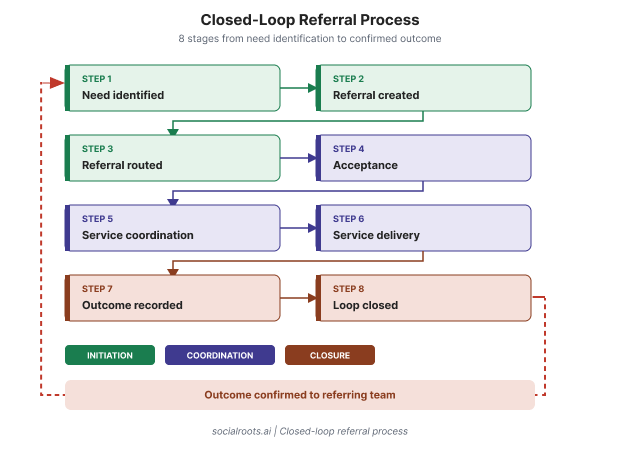
Figure 1: Closed-loop referral process: from identifying a patient need to confirming the outcome with the referring organization. The dashed return path shows the loop closing back to the referring care team.
What Makes a Referral Closed-Loop?
Sending a referral does not close the loop. A closed-loop referral requires bidirectional communication between the referring and receiving organizations throughout the referral lifecycle. The loop is closed when the referring care team receives a documented status update confirming the referral's disposition.
Closure does not always mean successful service delivery. A referral can be appropriately closed with any documented disposition:
- Service completed and delivered
- Appointment completed
- Patient declined services
- Provider capacity unavailable
- Patient could not be reached
- Patient not eligible for the referred service
- Need resolved through another pathway
- Referred elsewhere by the receiving organization
The important distinction is that every referral has a documented outcome rather than simply disappearing after submission.
Open-Loop vs Closed-Loop Referrals
| Open-Loop Referral | Closed-Loop Referral |
|---|---|
| Referral is sent; process ends | Referral is tracked end-to-end |
| Limited visibility after submission | Real-time status at every stage |
| One-way communication | Bidirectional communication |
| Outcome often unknown | Outcome documented and returned |
| Referral leakage can go undetected | Unresolved referrals identified for follow-up |
| Limited performance data available | Referral analytics and outcome reporting available |
For more on what happens when referrals go untracked, see our guide to referral leakage in healthcare.
The 8 Steps of a Closed-Loop Referral Process
Step 1: Identify the patient's need.
The process begins when a healthcare provider, care coordinator, or community partner identifies a clinical or social need during a primary care visit, hospital discharge planning, emergency department encounter, care management program, or SDOH screening assessment.
Step 2: Assess eligibility and referral requirements.
Before creating the referral, confirm that the patient meets eligibility criteria for the target service and that the referring organization has the information the receiving organization needs to accept the referral.
Step 3: Create the referral.
Document the referral with the patient's identified need, relevant clinical or social context, contact information, consent where required, and any eligibility documentation the receiving organization needs.
Step 4: Match and route the referral.
Use service type, geographic location, provider capacity, language access, eligibility requirements, and individual preferences to match the patient with the most appropriate provider or CBO, then route the referral through a structured workflow.
Step 5: Acknowledge receipt and acceptance.
The receiving organization reviews and accepts or declines the referral. Accepted referrals move forward; declined referrals trigger re-routing or care team outreach to the patient.
Step 6: Track scheduling and service delivery.
Monitor whether the patient schedules and attends the appointment or service. Care coordinators can identify patients who have not scheduled, cannot be reached, or encounter barriers requiring additional support.
Step 7: Document the outcome.
The receiving organization records the referral outcome: service delivered, appointment completed, patient declined, or other documented disposition within the referral management system.
Step 8: Communicate the outcome and close the loop.
The documented outcome is communicated back to the referring organization, completing the bidirectional communication cycle and closing the referral with a verified status.
Closed-Loop Referral Examples
Example 1: Food Insecurity SDOH Referral
A patient screens positive for food insecurity during a primary care visit. A care coordinator creates a referral to a local food assistance CBO, which accepts the referral, contacts the patient, and enrolls them in a food support program. Once services begin, the CBO updates the referral status with the outcome. The clinic receives confirmation and closes the referral with documented evidence that the patient's need was addressed.
Example 2: Behavioral Health Referral
A primary care provider identifies a patient needing behavioral health support. A referral is created and routed to a behavioral health provider with available capacity. The provider accepts the referral, schedules the patient, and delivers an initial session. The referring provider receives confirmation that the appointment was completed and documents the referral as closed.
Example 3: Housing Instability Referral
A community health worker identifies housing instability during a home visit. A referral is created to a housing assistance organization. The organization accepts the referral, contacts the patient, and connects them to housing stabilization services. The outcome is documented and returned to the referring organization, closing the loop with a confirmed service record.
Closed-Loop Referrals for SDOH
Social determinants of health referrals present particular challenges for traditional referral workflows because they involve community organizations outside the clinical system, often serve patients with multiple simultaneous social needs, and require bidirectional communication across organizations that may use different systems.
Closed-loop referral workflows address SDOH by connecting patients to CBOs for housing, food, transportation, employment, behavioral health, financial assistance, utility support, and other community services, while tracking whether those services were actually delivered. This creates a measurable connection between identified social need and community response. For more on SDOH referral management, see our guide to referrals in health and social care.
Roles and Responsibilities
| Stakeholder | Responsibility |
|---|---|
| Provider | Identify need and initiate referral with required clinical or social context |
| Care coordinator | Route the referral, monitor status, and intervene when referrals stall |
| Patient | Participate in scheduling and service engagement |
| Specialist or CBO | Accept the referral, deliver the service, and document the outcome |
| Referral coordinator | Monitor unresolved referrals and ensure timely follow-up |
| Health system or network | Track network-level referral performance and partner accountability |
Key Metrics for Closed-Loop Referral Management
- Referral completion rate: Completed referrals divided by total referrals: the primary measure of referral follow-through
- Referral acceptance rate: Accepted referrals divided by total referrals: indicates network capacity and referral quality
- Referral closure rate: Referrals with a documented disposition divided by total referrals: measures documentation completeness
- Time to acceptance: Time between referral submission and receiving organization acknowledgment
- Time to service: Time between referral creation and confirmed service delivery
- Referral leakage rate: Percentage of referrals that remain unresolved or fail to reach service delivery
- No-contact rate: Percentage of referrals where the patient could not be reached after acceptance
- Patient outcome rate: Percentage of completed referrals associated with the intended service or documented outcome
Why Referrals Fail to Close
- Missing or incomplete patient information required for referral acceptance
- Referral routed to a provider without available capacity
- Patient cannot be reached after the referral is accepted
- Transportation barriers preventing appointment attendance
- Insurance or eligibility issues discovered after referral submission
- Long wait times reducing patient follow-through
- No defined ownership of follow-up responsibility
- Lack of visibility into referral status after submission
- Outdated provider or CBO directory leading to mismatched referrals
Technology That Enables Closed-Loop Referrals
Managing closed-loop referrals manually through spreadsheets, fax, email, and phone follow-up becomes unreliable as referral volume grows and partner networks expand. Closed-loop referral platforms provide the digital infrastructure to manage the process at scale:
- Digital referral creation and routing with structured intake fields
- Provider and CBO directories with capacity, eligibility, and service information
- Real-time referral status tracking across all stages
- Bidirectional communication between referring and receiving organizations
- Automated notifications for pending, overdue, or unresolved referrals
- Outcome documentation with configurable closure reasons
- EHR integration through FHIR-based APIs enabling clinical and social care workflows to stay connected
- Referral analytics and performance reporting across the network
For more on how FHIR-based integration enables closed-loop referral workflows, see our guide to FHIR and closed-loop referrals.
Learn About the PlatformHow GridSocial Supports the Closed-Loop Referral Process
GridSocial by SocialRoots.ai is a closed-loop referral management platform designed for healthcare organizations, health plans, FQHCs, and CBOs. The platform maps directly to the closed-loop referral process:
| Referral Stage | GridSocial Capability |
|---|---|
| Identify need | Centralized intake and SDOH screening workflows |
| Create and route referral | Digital referral creation and intelligent routing |
| Match to provider or CBO | Partner directory with service, capacity, and eligibility data |
| Track status | Real-time referral status visibility across all stages |
| Communicate across organizations | Bidirectional partner collaboration tools |
| Document outcome | Outcome management and closure documentation |
| Measure and report | Referral analytics across completion, leakage, and network performance |
Ready to Close the Loop on Every Referral?
GridSocial by SocialRoots.ai helps healthcare organizations, FQHCs, CBOs, and health plans track referrals from intake through confirmed outcome, so no referral disappears without a documented result.
Explore GridSocial Request a DemoClosed-Loop Referral Best Practices
- Define ownership for every referral, so follow-up responsibility is never ambiguous
- Standardize referral statuses so all partners use consistent terminology
- Maintain accurate, current provider and CBO directories with real-time capacity data
- Match referrals based on eligibility, language, geography, and service capacity rather than availability alone
- Set response-time expectations with partner organizations and monitor adherence
- Track every referral until a disposition is documented: not just until it is sent
- Build bidirectional communication into the workflow from the start
- Integrate with the EHR where appropriate to reduce duplicate data entry
- Monitor referral completion, leakage, and time-to-service metrics regularly
- Continuously evaluate community partner performance and network coverage gaps
Here Is What Matters Most
- A referral is not complete when it is sent. The loop closes only when the referring organization receives documented confirmation of the outcome.
- Closure does not require success. A referral can be appropriately closed with any documented disposition, including patient declined, provider unavailable, or need resolved elsewhere.
- Every referral needs a defined owner. Without assigned follow-up responsibility, referrals stall and leakage goes undetected.
- SDOH referrals require the same rigor as clinical referrals. Social needs that are identified but not tracked to confirmed delivery remain unaddressed regardless of intent.
- Metrics drive improvement. Completion rate, leakage rate, and time to service reveal where referral workflows need attention and where partner networks need development.
Final Thoughts
A closed-loop referral process transforms a referral from a one-time transaction into a coordinated care journey with a verified outcome. The difference between an open-loop and closed-loop referral is not technical; it is the difference between hoping a patient received services and knowing they did. For healthcare organizations, CBOs, health plans, and community care networks building toward measurable social care outcomes and value-based care accountability, the closed-loop referral process is the operational foundation that makes those goals achievable.
Related Articles
- What Is Referral Leakage in Healthcare? Definition, Causes, and Prevention
- Social Care Referral Platform: A Complete Guide to Closed-Loop Referrals
- Referrals in Health and Social Care: A Guide to Coordinated Community Support
- Closed-Loop vs Traditional Referrals: A Practical Comparison
- SDOH and Closed-Loop Referrals: A Simple Guide
Frequently Asked Questions
A closed-loop referral process tracks a healthcare referral from identification of a need through creation, routing, acceptance, service delivery, outcome documentation, and confirmation back to the referring organization. The loop closes when the referring team receives a documented status on the referral's outcome.
Bidirectional communication between the referring and receiving organizations throughout the referral lifecycle, ending with a documented outcome returned to the referring care team. The loop is not closed by sending the referral: it is closed by confirming what happened after.
An open-loop referral ends when it is sent, with no structured tracking of what happens afterward. A closed-loop referral tracks status at every stage and documents the outcome, giving referring organizations visibility into whether the patient received the intended service.
Because healthcare organizations cannot coordinate care or measure outcomes for referrals they cannot track. Without visibility into referral status, patients with complex needs can fall through gaps between providers and community organizations. Closed-loop referrals let care teams identify unresolved referrals and intervene.
Referral leakage occurs when a referral is sent, but the patient does not receive the intended service and the referring organization has no visibility into what happened. Closed-loop tracking identifies where referrals stall so care teams can act. See our guide to referral leakage in healthcare.
By tracking referrals to CBOs for housing, food, transportation, employment, and other social services through confirmed delivery, creating a documented connection between identified social need and community response.
Referral completion rate, acceptance rate, closure rate, time to acceptance, time to service, referral leakage rate, no-contact rate, and patient outcome rate. These metrics identify where referral workflows need improvement and where partner networks have coverage gaps.
Digital referral platforms providing referral routing, provider and CBO directories, real-time status tracking, bidirectional communication, outcome documentation, EHR integration through FHIR-based APIs, and referral analytics. See our guide to the closed-loop referral system.