Multi-Network Referral Management: Scaling Closed-Loop Care Across Provider and Community Networks
Introduction: The Challenge of Fragmented Referral Networks
Healthcare organizations rarely operate in isolation.
Patients often require services across:
- Hospitals and clinics
- Community-based organizations (CBOs)
- Social service providers
- Government and nonprofit programs
Yet most referral systems are built for single-network workflows.
The result:
- Disconnected referrals
- Limited visibility across networks
- Poor coordination between providers and community partners
To address this, organizations need multi-network referral workflows powered by closed-loop systems.
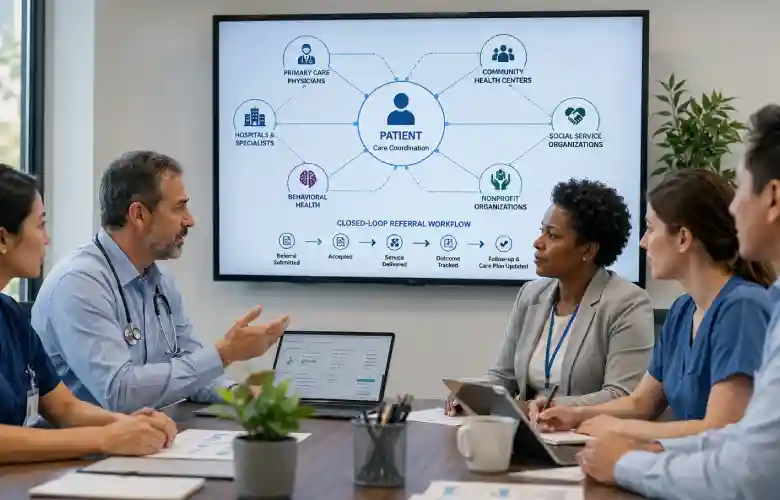
What is a Multi-Network Referral Workflow?
A multi-network referral workflow enables healthcare organizations to:
- Route patients across multiple providers and community networks
- Access a centralized directory of services
- Match patients with the most appropriate provider
- Track referrals across organizational boundaries
- Capture outcomes across the entire ecosystem
It transforms fragmented systems into a connected referral network
Why Traditional Referral Systems Fail in Multi-Network Environments
1. Siloed Networks
Each organization operates independently with:
- Separate systems
- Limited data sharing
- No unified visibility
2. Manual Provider Matching
Care teams rely on:
- Static lists
- Personal knowledge
- Manual outreach
Leads to delays and mismatches
3. Lack of Cross-Network Visibility
Once a referral leaves one network:
- Status becomes unclear
- Follow-ups become manual
- Outcomes are not tracked
4. No Scalable Infrastructure
Traditional systems cannot:
- Expand partner networks easily
- Maintain data consistency
- Coordinate across multiple organizations
Step-by-Step: Multi-Network Referral Workflow
1. Cross-Network Patient Intake
Patient needs captured through digital or assisted intake
Requests categorized based on service type
Ensures standardized data across networks
2. Network Directory & Service Discovery
Access a unified directory of:
- Providers
- Community organizations
- Available services
Enables faster and accurate service identification
3. Intelligent Provider Matching
Patients matched based on:
- Eligibility
- Location
- Service availability
- Urgency
Eliminates manual searching
4. Cross-Network Referral Routing
Referrals routed to the appropriate organization
Supports coordination across different networks
Ensures patients reach the right provider regardless of network boundaries
5. Outcome Tracking Across Networks
Track:
- Referral status
- Service delivery
- Outcomes and feedback
Maintains accountability across the entire ecosystem
Real-World Use Case: Coordinating SDOH Services Across Networks
A patient requires multiple services:
- Food assistance
- Transportation support
- Mental health counseling
Instead of navigating multiple systems:
- A single request is submitted
- The system identifies providers across different networks
- Referrals are routed to multiple organizations
- Each organization updates its status in real time
- Outcomes are tracked centrally
Result:
- Coordinated care delivery
- Reduced duplication
- Improved patient outcomes
Key Capabilities Required for Multi-Network Referral Management
To operate effectively across networks, systems must provide:
Unified Referral Network Database
Centralized directory of verified providers and services
Intelligent Routing & Matching
Automated assignment based on defined criteria
Cross-Organization Collaboration
Secure communication between providers and partners
Real-Time Tracking
Visibility into referral status across all networks
Outcome Reporting
Measure success across providers and community organizations
How Multi-Network Workflows Enable Closed-Loop Care
A multi-network approach becomes powerful when combined with closed-loop tracking:
- Every referral is tracked across networks
- Every provider contributes updates
- Every outcome is recorded
This ensures:
- No referral is lost
- No patient falls through the cracks
- Every interaction is measurable
How GridSocial Enables Multi-Network Referral Management
GridSocial enables organizations to coordinate referrals across multiple networks through a unified, closed-loop platform:
Scalable Partner Network
Easily onboard and manage multiple providers and community organizations
Unified Referral Network Database
Access a centralized directory to identify and connect with trusted partners
Smart Cross-Network Routing
Automatically match patients to the right service across networks
Real-Time Collaboration
Enable communication and coordination between organizations
End-to-End Outcome Tracking
Track referrals from submission to completion across all participating networks
The result:
A connected, scalable referral ecosystem that improves coordination and outcomes
Business Impact of Multi-Network Referral Workflows
Organizations adopting multi-network workflows experience:
- Improved cross-network coordination
- Faster service delivery
- Higher referral completion rates
- Reduced administrative overhead
- Enhanced reporting for funding and compliance
Conclusion: Building Scalable, Connected Care Ecosystems
Healthcare delivery increasingly depends on collaboration across networks.
Multi-network referral workflows enable organizations to:
- Break down silos
- Scale partnerships
- Deliver coordinated care
When powered by a closed-loop system, these workflows ensure:
- Full visibility
- Strong accountability
- Measurable outcomes
Looking to scale care coordination across multiple providers and community networks?
Discover how GridSocial enables multi-network, closed-loop referral management.