Closed-Loop Referral Workflows: A Step-by-Step Guide for Healthcare Teams
Healthcare referrals can become difficult to manage once a patient leaves the referring provider's workflow. A referral may be sent to a specialist or community organization, but without consistent follow-up, care teams may not know whether it was received, accepted, scheduled, completed, or declined.
A closed-loop referral workflow addresses this gap by tracking the referral from the initial request through service completion and documented outcome.
For clinics, FQHCs, community health centers, health plans, and care teams, closed-loop referral workflows create a structured process for coordinating specialty care and community services while improving visibility, accountability, and follow-through.
What Is a Closed-Loop Referral Workflow?
A closed-loop referral workflow is a healthcare process that tracks a referral from creation through acceptance, scheduling, service delivery, and documented outcome.
Unlike a traditional referral process that may end once a referral is sent, a closed-loop workflow keeps the care team informed about what happens next.
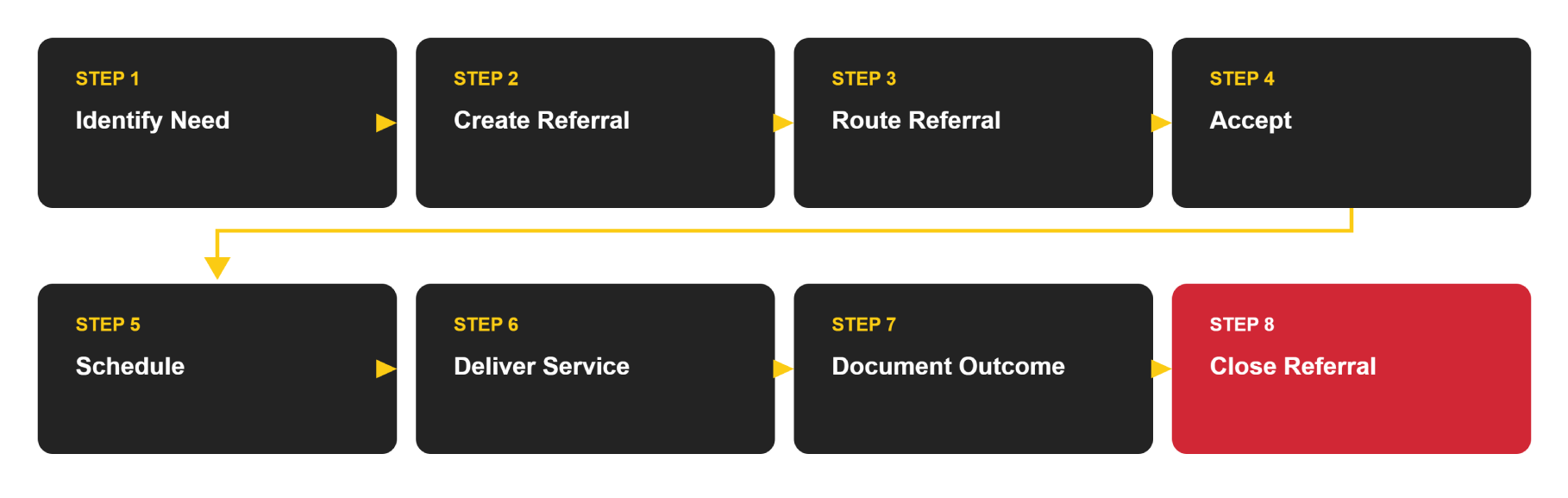
The goal is simple: instead of wondering what happened after a referral was sent, care teams can follow the patient's journey and take action when something is delayed or incomplete.

Why Closed-Loop Referral Workflows Matter
Referral coordination often involves multiple providers, specialists, community-based organizations (CBOs), and care team members. Without a standardized workflow, information can become fragmented across phone calls, fax systems, emails, spreadsheets, and disconnected applications.
A structured workflow brings these activities into a clearer process. Care teams can track referral status, reduce manual follow-up, identify delayed referrals, improve communication with partners, and document whether the patient ultimately received the required service.
This is particularly important for organizations managing specialty care, behavioral health, or social needs, where several people and organizations may be involved before a patient's need is fully addressed.
Closed-Loop Referral Workflow: 8 Steps
A closed-loop referral workflow typically includes eight connected stages.
1. Identify the Patient's Need
The process begins when a clinician, care manager, or another authorized care team member identifies that a patient needs additional support or services.
This may involve specialty care, behavioral health, food assistance, housing support, transportation, medication assistance, preventive care, or another community service.
Example: A patient with hypertension may require a nephrology consultation while also experiencing food insecurity. The care team can identify both needs and create separate referrals as part of the patient's broader care plan.
2. Collect the Required Information
Before sending the referral, the care team gathers the information the receiving organization needs to understand and act on the request. This may include patient demographics, the reason for referral, relevant clinical notes, diagnoses, urgency level, insurance or program eligibility, medications, test results, and supporting documents.
Collecting the right information at the beginning helps reduce unnecessary delays and prevents referrals from being returned because important details are missing.
3. Route the Referral to the Right Partner
The referral is then sent to the most appropriate provider, specialist, or community organization.
Depending on the patient's needs, this could be a specialty provider, behavioral health organization, primary care provider, social service agency, community-based organization, or another care partner.
Referral management platforms can help match referrals based on factors such as service type, location, eligibility, availability, and existing organizational relationships.
4. Partner Receives and Accepts the Referral
The receiving organization reviews the referral and determines whether it can provide the requested service. The organization may accept the referral, decline it, redirect it to another provider, or request additional information.
Recording this response matters because sending a referral does not guarantee someone has agreed to provide the service. Status visibility helps the referring team understand what happened and decide whether additional action is needed.
5. Track the Referral Status
Once the referral is accepted, the care team can follow its progress through defined stages.
A typical workflow may look like:

Additional statuses may include unable to reach patient, declined, canceled, redirected, or awaiting information.
Real-time tracking helps care teams identify referrals that are delayed or stuck, rather than discovering the problem weeks later when the patient returns for another appointment.
6. Support Patient Follow-Through
A referral can still fail even when the receiving organization accepts it. Patients may face transportation problems, financial barriers, language challenges, scheduling difficulties, or uncertainty about what to do next.
Care teams may support patients through appointment reminders, instructions, transportation coordination, paperwork assistance, and follow-up outreach.
This step is especially important because the referral process is only successful when the patient can connect with the service they need.
7. Confirm Service Completion
After the patient receives the service, the receiving organization records the relevant information. Depending on the referral, this may include the date of service, service provided, outcome, follow-up recommendations, additional care needs, or relevant notes.
This step confirms that the service actually occurred. A referral is not complete simply because it was sent or accepted.
8. Document the Outcome and Close the Referral
The final step is to document the outcome and update the appropriate patient or referral record.
The care team may update the care plan, record the referral outcome, schedule additional follow-up, create another referral if necessary, or formally close the referral.
A completed referral record creates a clear history of what happened and supports continuity of care, reporting, and quality management.
Closed-Loop Referral Workflow vs. Traditional Referral Workflow
| Traditional Referral Workflow | Closed-Loop Referral Workflow |
|---|---|
| Referral is sent with limited visibility | Referral status remains visible throughout the process |
| Scheduling status may be unknown | Scheduling progress can be tracked |
| Follow-up often depends on phone calls or manual checks | Alerts can help identify delayed referrals |
| Service completion may not be confirmed | Service completion can be documented |
| Referral outcomes may be difficult to locate | Outcomes can be recorded in a centralized workflow |
| Referral performance is difficult to measure | Organizations can monitor referral performance |
| Patients may experience follow-up gaps | Care teams can identify and address stalled referrals |
The biggest difference is what happens after the referral is sent. Traditional workflows may focus primarily on sending the referral, while closed-loop workflows track the entire journey until the outcome is known.
Closed-Loop Referral Workflows for Specialty Care
Specialty referrals are a common use case for closed-loop referral management.
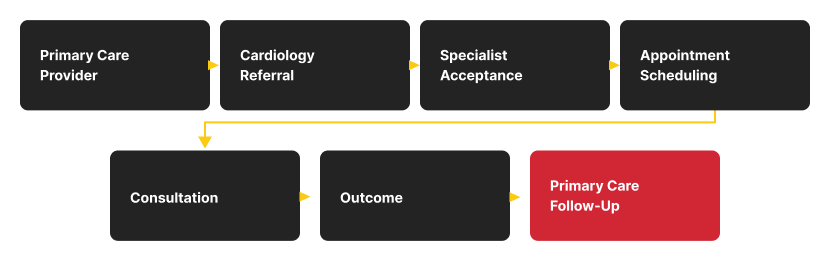
For example, a primary care provider may refer a patient to a cardiologist. Instead of simply sending the referral and waiting for information to return, the workflow can track whether the specialist accepted the referral, whether the patient scheduled and attended the appointment, and whether the outcome was communicated back to the primary care team.
The journey may look like this:
Closed-Loop Referral Workflows for Community Services
Closed-loop workflows are also useful when healthcare organizations connect patients with community services.
For example, a patient may screen positive for food insecurity. A care manager identifies the need, creates a referral to an appropriate community-based organization, and tracks whether the organization accepts the referral and whether the patient receives assistance.
Once the service is delivered, the outcome can be documented and communicated back to the care team. This creates a clearer connection between the patient's identified need and the support they ultimately received.
Closed-Loop Referrals for SDOH
Social determinants of health (SDOH) referrals often require coordination between healthcare organizations and community partners.
Common referral needs may include food assistance, housing support, transportation, utility assistance, employment support, financial assistance, behavioral health services, and other community resources.
A closed-loop workflow helps organizations move from identifying a social need to connecting the patient with the right resource and documenting what happened afterward. This creates a more consistent process for connecting screening, referral, service delivery, and outcome documentation.
Example of a Closed-Loop Referral Workflow
Consider a patient with diabetes who reports food insecurity during a routine visit.
The care team identifies two needs: diabetic foot care and food assistance. The care team creates a referral for a podiatrist and sends another referral to an appropriate community organization. Both receiving organizations review and accept the referrals; the patient receives the required services, and the relevant outcomes are documented.
The care team can then update the patient's record and care plan with the information received from both referrals.
The result is a complete referral journey rather than a referral that disappears after it is sent.
How Technology Supports Closed-Loop Referral Management
Technology can help healthcare organizations standardize and manage referral workflows more effectively.
A referral management platform can support automated routing based on predefined criteria, provide real-time status visibility, and notify care teams when referrals require attention. It can also support patient follow-up through reminders and outreach workflows.
Integration with electronic health records can reduce duplicate data entry and help referral information move between clinical workflows and referral management systems. FHIR and HL7-based interoperability can further support structured information exchange between EHRs, referral platforms, healthcare applications, and other connected systems.
Together, these capabilities can help organizations track referrals from creation through service delivery and documented outcomes.
Key Closed-Loop Referral Metrics to Track
Referral data can help organizations understand where patients experience delays and where workflows need improvement.
Important metrics include:
| Metric | What It Measures |
|---|---|
| Referral completion rate | Percentage of referrals that result in completed services |
| Referral turnaround time | Time between referral creation and service completion |
| Referral acceptance rate | Percentage of referrals accepted by receiving organizations |
| Unable-to-reach rate | Referrals where the patient could not be contacted |
| No-show rate | Percentage of scheduled referrals that patients do not attend |
| Referral leakage rate | Referrals that do not reach the intended outcome |
| Outcome documentation rate | Completed referrals with a documented outcome |
Tracking these metrics can help care teams identify bottlenecks, improve partner coordination, and strengthen overall referral performance.
How GridSocial Supports Closed-Loop Referral Workflows
GridSocial by SocialRoots.ai helps healthcare organizations manage referrals through a connected workflow from referral creation to documented outcome.
The platform supports referral routing to providers and community-based organizations, real-time status tracking, automated follow-up and notifications, patient and partner coordination, SDOH referral management, outcome tracking, interoperability, and workflow reporting.
For organizations managing both clinical and social referrals, GridSocial provides a structured approach to connecting patients with appropriate services while maintaining visibility throughout the referral journey.
Frequently Asked Questions
A closed-loop referral workflow tracks a healthcare referral from creation through acceptance, scheduling, service completion, and documented outcome.
A closed-loop referral system tracks each stage of the referral process. It helps care teams see whether the referral was received, accepted, scheduled, completed, and documented.
An open-loop referral may end once the referral is sent, with limited visibility into what happens afterward. A closed-loop referral tracks the process until the outcome is known and communicated back to the referring team.
FQHCs often coordinate clinical care and social services across multiple providers and community organizations. Closed-loop workflows can help improve visibility, follow-up, and coordination across those referral relationships.
Yes. Closed-loop workflows can help organizations track referrals for food, housing, transportation, behavioral health, and other social needs from referral creation through service delivery and documented outcome.
FHIR can support structured data exchange between healthcare systems. In referral workflows, it can help connected systems exchange relevant referral information, status updates, and outcomes.
Organizations may track referral completion rates, turnaround time, acceptance rates, no-show rates, referral leakage, and outcome documentation rates to understand referral performance and identify areas for improvement.
Conclusion
Closed-loop referral workflows create a structured path from referral to outcome. By tracking each stage of the process, healthcare organizations can improve visibility, reduce follow-up gaps, coordinate more effectively with providers and community organizations, and document whether patients received the services they needed.
For clinics, FQHCs, health plans, and care teams, the goal is not simply to send more referrals. The goal is to create a process where every referral has a clear status, delays can be identified, and outcomes are documented.
GridSocial helps healthcare organizations build connected closed-loop referral workflows that support clinical referrals, SDOH services, partner coordination, and referral outcome tracking.
Ready to strengthen your referral workflows?
Explore how GridSocial can help your organization route, track, and manage healthcare and social care referrals.
Contact usMore from SocialRoots.ai
GridSocial — Closed-loop referral management for connecting healthcare organizations, providers, and community-based organizations.
Pillar — Healthcare management and patient record capabilities designed to support modern care workflows.
EHR Integration & Interoperability — Connect healthcare applications and workflows across existing systems.
EHR Migration — Support for migrating legacy EHR environments with predictable implementation timelines.
EHR Log Tracker — Monitor EHR activity and identify workflow anomalies.