Closed-Loop Referral Challenges in Healthcare: 10 Common Gaps and How to Fix Them
Closed-loop referral management helps healthcare organizations track a referral from creation through scheduling, service delivery, follow-up, and documented outcomes. However, many healthcare organizations still struggle to keep referrals visible and moving across providers, specialists, community organizations, and patients.
Common closed-loop referral challenges include incomplete referral information, delayed partner responses, limited visibility, missed appointments, fragmented communication, inconsistent workflows, and missing outcomes.
These gaps can lead to referral leakage, longer wait times, additional administrative work, and patients falling out of care.
This guide explains the 10 most common closed-loop referral challenges, where they occur in the referral lifecycle, and practical ways healthcare organizations can address them.

What Is a Closed-Loop Referral?
A closed-loop referral is a referral workflow that lets the referring organization track what happens after a referral is sent.
A typical closed-loop referral workflow includes:
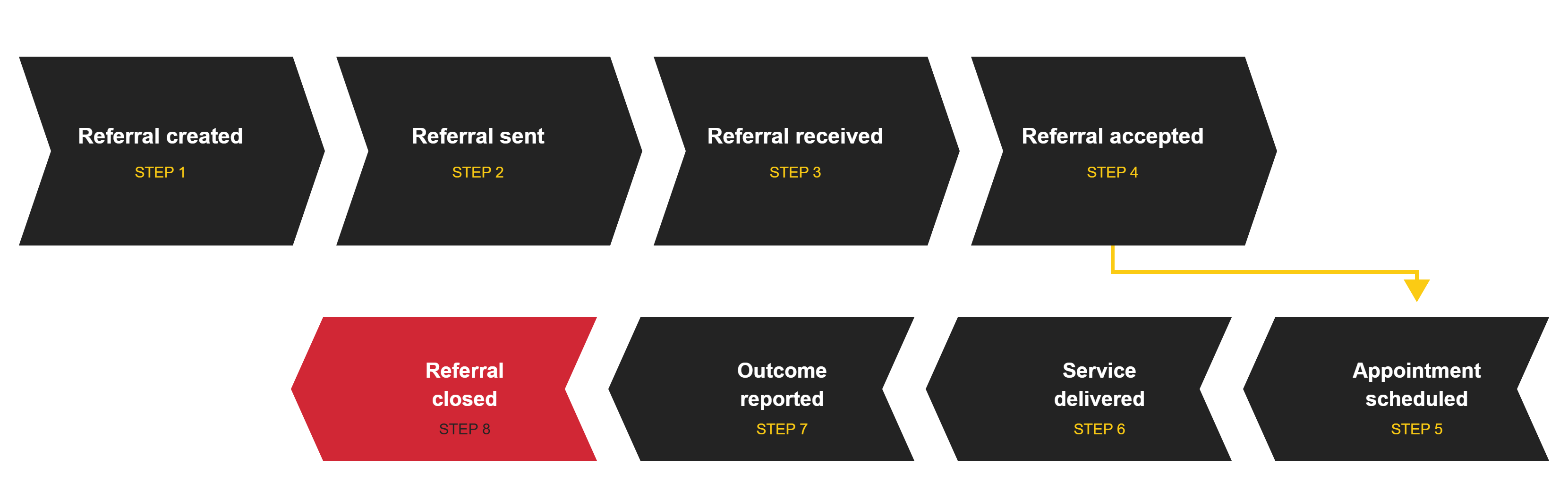
Unlike a traditional referral process, the referring team does not simply send the referral and assume the patient received care. Each stage can be tracked and followed up when necessary.
This visibility helps healthcare organizations identify stalled referrals, coordinate with external partners, and confirm whether patients actually received the referred service.
Where Closed-Loop Referrals Break Down
Referral problems can occur at almost every stage of the referral lifecycle.
| Referral stage | Common gap | Potential consequence |
|---|---|---|
| Referral creation | Missing patient or referral information | Partner cannot process referral |
| Referral transmission | Fax, email, or disconnected systems | Referral is delayed or lost |
| Referral receipt | No confirmation | Referrer does not know whether partner received it |
| Referral acceptance | Delayed response | Patient waits longer for care |
| Scheduling | Limited coordination | Missed appointments or delays |
| Service delivery | No status update | Referrer loses visibility |
| Outcome reporting | Missing documentation | Care plan remains incomplete |
| Referral closure | No confirmation of completion | Referral leakage and reporting gaps |
Understanding these failure points is essential for improving referral performance.
10 Closed-Loop Referral Challenges in Healthcare
1. Missing or Incomplete Referral Information
Many referral problems begin before the referral even reaches the receiving organization.
A referral may be missing important clinical, demographic, eligibility, or program information.
Common gaps include:
- Missing reason for referral
- Incomplete patient demographics
- Missing clinical notes or test results
- Incorrect contact information
- Missing urgency or priority
- Incomplete insurance or eligibility information
- Missing documentation required by the receiving organization
Why this creates a problem
The receiving organization may need to contact the referring team for clarification before processing the referral. This adds another communication step and can delay care.
How to solve it
Healthcare organizations can reduce incomplete referrals by using standardized referral forms, required fields, validation rules, and structured intake workflows.
A centralized referral workflow can also identify missing information before a referral is transmitted.
2. Delays in Partner Response
A referral is not closed simply because it was sent.
The receiving provider, specialist, or community organization must acknowledge the referral and take the next step.
However, responses may be delayed because of:
- High referral volumes
- Staffing shortages
- Disconnected systems
- Missed notifications
- Fax and email workflows
- Manual referral queues
- Different operating hours across organizations
Impact
When referrals remain unanswered, referring teams may not know whether the patient is moving forward.
Patients may wait longer for appointments or contact the healthcare organization repeatedly for updates.
How to solve it
Referral workflows should capture:
- Date sent
- Date received
- Acceptance status
- Assigned organization
- Assigned staff member
- Response deadline
- Current referral status
Automated alerts and escalation rules can help teams identify referrals that remain unacknowledged beyond a defined timeframe.
3. No Real-Time Visibility Into Referral Status
One of the most important closed-loop referral challenges is the lack of visibility after a referral leaves the referring organization.
Without centralized tracking, staff may not know whether a referral is:
- Sent
- Received
- Accepted
- Rejected
- Pending
- Scheduled
- Completed
- Unable to contact
- Closed
Why this matters
Without status visibility, staff often rely on phone calls, emails, spreadsheets, or manual notes to determine what happened.
This increases administrative workload and makes it difficult to identify stalled referrals.
How to solve it
A referral management workflow should provide a centralized view of referral status and allow authorized users to see where each referral is in the process.
Real-time or near-real-time status updates can help teams intervene before a referral becomes a missed care opportunity.
4. Follow-Up Gaps and Missed Appointments
Even when a referral is successfully accepted, the patient may not complete the next step.
Patients can face barriers such as:
- Transportation problems
- Childcare responsibilities
- Financial limitations
- Lack of appointment availability
- Language barriers
- Digital access limitations
- Confusion about where to go
- Difficulty contacting the provider
Impact
A referral can appear successful from an administrative perspective, but the patient may never actually receive the service.
How to solve it
Organizations can strengthen follow-up by using:
- Automated reminders
- Patient outreach
- Appointment status tracking
- Escalation workflows
- No-show follow-up
- Care navigator intervention
- Alternative service routing
The goal is to track the patient journey rather than treating referral transmission as the endpoint.
5. Breakdowns Across Multiple Organizations
Healthcare referrals frequently cross organizational boundaries.
A single patient may interact with:
- Primary care providers
- Specialists
- Hospitals
- FQHCs
- Behavioral health organizations
- Social service agencies
- Community-based organizations
- Transportation providers
- Food assistance programs
Each organization may use different software, processes, and communication methods.
Why this creates a problem
Without shared visibility, each organization may see only part of the referral journey.
This creates gaps in:
- Referral status
- Patient communication
- Appointment information
- Service completion
- Outcome reporting
How to solve it
Organizations should establish standardized referral workflows and provide appropriate visibility to participating referral partners.
Interoperability can further reduce manual data exchange by connecting referral workflows with existing healthcare and community systems.
6. Inconsistent Documentation and Missing Outcomes
A referral is not truly closed when the patient attends an appointment.
The referring organization also needs to know what happened.
For example:
- Was the service delivered?
- Was the patient eligible?
- Did the patient complete the program?
- Was additional follow-up required?
- Was the referral unsuccessful?
- Was the patient connected to another resource?
The challenge
Outcome information may be recorded in another system or communicated through email, phone calls, fax, or paper documentation.
As a result, the referring organization may never receive a complete outcome.
How to solve it
Standardized outcome fields can help organizations capture:
- Service received
- Completion status
- Date of service
- Referral outcome
- Follow-up required
- Reason for non-completion
- Additional services needed
This creates a more complete record of referral performance.
7. Limited Staff Capacity
Referral coordination can consume significant staff time.
Care coordinators and administrative teams may spend hours:
- Calling referral partners
- Checking appointment status
- Sending reminders
- Updating spreadsheets
- Searching email threads
- Confirming service completion
- Documenting referral outcomes
Impact
Manual tracking becomes increasingly difficult as referral volume grows.
High-volume organizations may struggle to follow every referral consistently.
How to solve it
Automation can reduce repetitive administrative work.
Useful capabilities include:
- Automated notifications
- Referral assignment
- Reminder workflows
- Escalation alerts
- Status updates
- Task management
- Referral dashboards
- Automated reporting
Automation should support staff rather than replace the human intervention required for complex patient situations.
8. Fragmented Communication Channels
Referral communication often happens across several channels at once.
A referral may involve:
- EHR messages
- Phone calls
- Fax
- External portals
- Text messages
- Paper documentation
- Spreadsheets
Why this creates a problem
Important information can become distributed across different systems.
A staff member may know that an appointment was scheduled while another team member is still working from an outdated referral status.
How to solve it
A centralized referral communication workflow can bring referral-related updates into one trackable process.
Instead of searching multiple systems, teams can access referral status, communication history, assigned tasks, and outcomes from a shared workflow.
9. Lack of Standardized Referral Workflows
Different departments and partner organizations may handle referrals differently.
For example, one department may require an intake form while another accepts referrals through email.
One organization may update referral status daily while another may provide updates only after the service is completed.
Common workflow problems
- Different intake requirements
- Inconsistent referral statuses
- Different response expectations
- Manual handoffs
- Unclear ownership
- No escalation process
- No standardized closure criteria
How to solve it
Organizations should define a consistent referral workflow with:
- Standardized intake
- Defined referral statuses
- Clear ownership
- Response time expectations
- Follow-up rules
- Escalation criteria
- Outcome documentation
- Closure requirements
Standardization makes referral performance easier to monitor across departments and partner networks.
10. Complex SDOH Referral Coordination
Social determinants of health referrals can be more difficult to manage than traditional clinical referrals.
A patient may need support for:
- Food insecurity
- Housing instability
- Transportation
- Employment
- Utilities
- Childcare
- Behavioral health
- Financial assistance
Community organizations may have different eligibility requirements, service areas, documentation requirements, and response times.
Why this creates a problem
A patient may be referred to an organization that cannot provide the required service or does not have available capacity.
Without closed-loop tracking, the referring team may not know whether the patient actually received assistance.
How to solve it
SDOH referral workflows should support:
- Resource matching
- Eligibility information
- Referral routing
- Partner communication
- Status tracking
- Patient follow-up
- Service outcomes
- Alternative resource routing
This is especially important when multiple community organizations are involved in a patient's care plan.
How to Solve Closed-Loop Referral Challenges
Addressing closed-loop referral challenges requires more than implementing a referral tracking tool.
Healthcare organizations should improve the entire referral workflow.
1. Standardize Referral Intake
Use required fields and consistent referral criteria to reduce incomplete referrals.
2. Create Clear Referral Statuses
Define standard statuses such as:
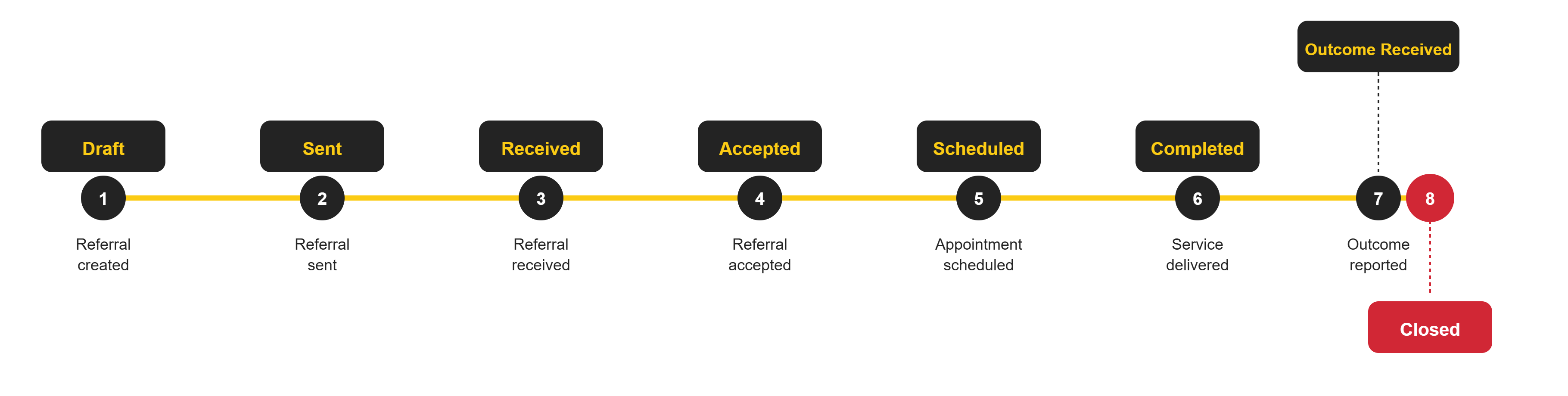
Draft → Sent → Received → Accepted → Scheduled → Completed → Outcome Received → Closed
This gives teams a common understanding of referral progress.
3. Automate Follow-Up
Use automated reminders and escalation rules for referrals that remain inactive beyond defined timeframes.
4. Centralize Referral Visibility
Give care teams a shared view of active, pending, overdue, and completed referrals.
5. Connect Healthcare and Community Workflows
When referrals move between clinical and social care organizations, interoperability can reduce manual information exchange and improve continuity.
6. Track Referral Outcomes
Measure what happened after the referral was sent rather than stopping at referral transmission.
7. Monitor Referral Leakage
Identify referrals that are never completed, rejected without an alternative, or lost during handoffs.
8. Use Data to Improve Referral Performance
Referral analytics can reveal:
- Organizations with long response times
- High no-show rates
- Referral bottlenecks
- Frequently rejected referrals
- High-leakage referral types
- Partner performance
- Average referral completion time
Closed-Loop Referral Management vs. Traditional Referral Workflows
| Traditional referral workflow | Closed-loop referral workflow |
|---|---|
| Referral is sent and manually followed up | Referral remains trackable |
| Limited visibility after transmission | Status is visible throughout the workflow |
| Follow-up depends heavily on staff | Automated reminders can support follow-up |
| Communication is spread across channels | Referral communication can be centralized |
| Outcomes may not return to the referrer | Outcomes can be documented and tracked |
| Difficult to identify stalled referrals | Stalled referrals can be escalated |
| Referral leakage is difficult to measure | Referral completion and leakage can be monitored |
The key difference is accountability after the referral is sent.
How to Measure Closed-Loop Referral Performance
Organizations should measure whether referrals are actually progressing and being completed.
Important closed-loop referral KPIs include:
- Referral completion rate – The percentage of referrals that result in completed services.
- Referral leakage rate – The percentage of referrals that fail to result in completed care or services.
- Referral response time – The time between referral transmission and partner acknowledgment.
- Time to appointment – The time between referral acceptance and scheduled service.
- Referral closure rate – The percentage of referrals that reach a defined closed status.
- Outcome documentation rate – The percentage of completed referrals with documented outcomes.
- No-show rate – The percentage of scheduled referrals where the patient does not attend or complete the service.
- Average referral cycle time – The average time from referral creation to referral closure.
Tracking these metrics gives organizations a clearer view of where referral workflows are performing well and where intervention is needed.
How GridSocial Helps Address Closed-Loop Referral Challenges
GridSocial provides a connected referral management workflow designed to help healthcare and community organizations coordinate referrals from intake through outcome.
It helps organizations:
- Centralize referral information
- Track referral status
- Route referrals to appropriate organizations
- Automate reminders and follow-up
- Coordinate across healthcare and community partners
- Document referral outcomes
- Identify stalled referrals
- Improve visibility across referral workflows
- Support SDOH referral coordination
- Monitor referral performance
Instead of treating referral transmission as the end of the process, GridSocial helps organizations maintain visibility through the complete referral journey.
This supports a more accountable workflow in which teams can identify stalled referrals, follow up with patients and partners, and document whether services were ultimately received.
When Should an Organization Consider Closed-Loop Referral Software?
A referral management platform can become particularly valuable when an organization:
- Manages high referral volumes
- Works with multiple external partners
- Uses manual referral tracking
- Relies heavily on phone, fax, or email
- Has difficulty tracking referral outcomes
- Experiences referral leakage
- Coordinates SDOH services
- Needs better visibility across referral networks
- Wants to standardize referral workflows
- Needs referral performance reporting
The right solution should complement existing healthcare workflows rather than create another disconnected system.
Frequently Asked Questions About Closed-Loop Referral Challenges
Closed-loop referral challenges are problems that prevent healthcare referrals from progressing from initiation to completed service and documented outcome. Common challenges include incomplete information, delayed responses, limited visibility, missed appointments, fragmented communication, and missing outcomes.
Referrals can fail because of incomplete information, disconnected systems, manual workflows, communication gaps, limited partner capacity, patient barriers, missed appointments, and lack of follow-up.
Referral leakage occurs when a patient referral does not result in completed care or services within the intended healthcare or referral network. Poor tracking and limited follow-up can make referral leakage difficult to identify.
Closed-loop referral systems provide visibility into referral status, support follow-up, coordinate communication, document outcomes, and help teams identify stalled referrals before they become missed care opportunities.
An open-loop referral typically ends from the referring organization's perspective once the referral is sent. A closed-loop referral continues to track the referral through receipt, scheduling, service delivery, outcome reporting, and closure.
Interoperability can help exchange referral and patient information between connected healthcare systems and external organizations. This can reduce manual data entry and improve continuity across referral workflows.
Organizations can reduce referral leakage by improving referral tracking, standardizing workflows, monitoring referral status, automating follow-up, identifying stalled referrals, and measuring referral completion and outcomes.
Conclusion
Closed-loop referral challenges can occur at every stage of the referral journey, from incomplete intake information to missing outcomes after services are delivered.
The most common gaps include delayed partner responses, limited referral visibility, patient follow-up problems, fragmented communication, inconsistent workflows, limited staff capacity, and complex SDOH coordination.
Organizations can address these challenges by standardizing referral workflows, automating follow-up, improving interoperability, centralizing referral visibility, and measuring referral completion and outcomes.
A successful closed-loop referral process does more than confirm that a referral was sent. It helps healthcare teams understand what happened next, where the referral is now, whether the patient received the service, and what action is required.
See how GridSocial can help your organization build a more connected closed-loop referral workflow.
Explore GridSocial Book a GridSocial DemoClosed-Loop vs Traditional/Manual Referrals | SDOH & Closed-Loop Referrals | Community Referral Coordination | Care Navigation Workflows | Referral Leakage Prevention | Tracking Gaps in Referral Systems | No-Show Follow-Up Workflows | Automation in Closed-Loop Referrals | Closed-Loop Software Comparison Guide | Closed-Loop ROI & Impact | FHIR & Interoperability in Closed-Loop Systems | Closed-Loop Referral Workflows | Challenges in Closed-Loop Systems
About SocialRoots.ai Interoperability Solutions;
Legacy EHR Migration – Guaranteed 90 Days shift
EHR Integration and Interoperability Solutions
Pre-built Salesforce Integration
More About SocialRoots.ai Healthcare Suite: