Clinical Referral Management: Why Healthcare Organizations Need More Than an EHR
Quick Summary
Clinical referral management is the process of coordinating, tracking, and completing patient referrals between healthcare providers, specialists, hospitals, and community organizations. While Electronic Health Records (EHRs) document referral orders, they typically do not provide end-to-end visibility into referral acceptance, scheduling, completion, or outcomes. Dedicated referral management platforms can support closed-loop referrals, help reduce referral leakage, improve care coordination, and provide analytics for value-based care programs.
What Is Clinical Referral Management?
Clinical referral management is the structured process of ensuring that a patient's referral successfully moves from the originating provider to the appropriate receiving organization and ultimately results in completed care.
The process extends far beyond creating a referral order. It involves identifying the right provider, routing referrals, confirming receipt, scheduling appointments, tracking patient progress, documenting outcomes, and communicating results back to the referring clinician.
As healthcare organizations increasingly coordinate care across hospitals, specialty providers, Federally Qualified Health Centers (FQHCs), behavioral health organizations, managed care plans, and community-based organizations, referral management has become a critical operational function that directly impacts patient outcomes and organizational performance.
Without effective referral coordination, patients may experience delays, duplicate testing, missed appointments, fragmented communication, and gaps in continuity of care.

The Clinical Referral Lifecycle
Every referral follows a series of operational steps that require visibility and coordination across multiple organizations:
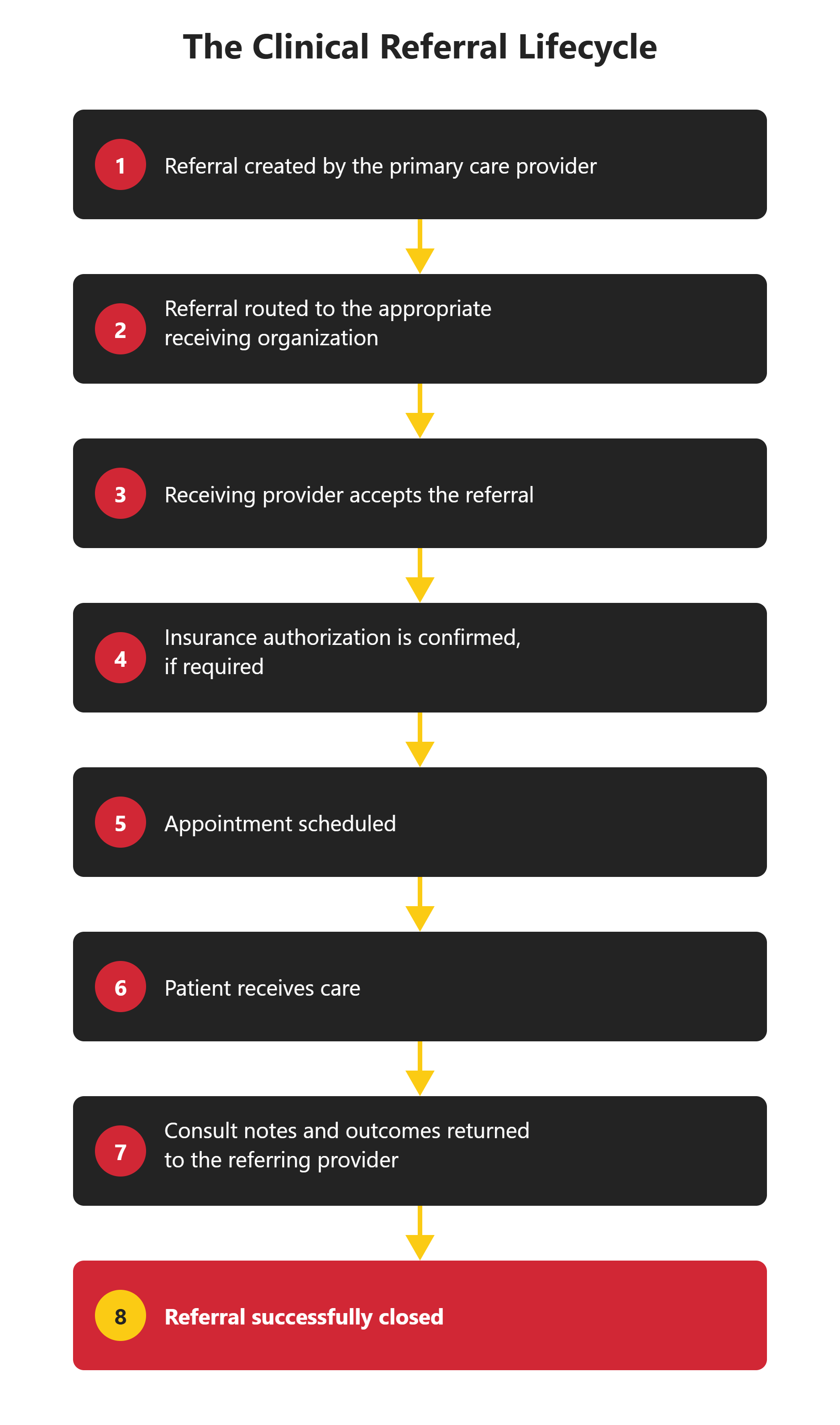
A referral should not be considered complete simply because it was sent. Successful referral management requires confirmation that care was delivered and outcomes were communicated back to the originating care team.
Why Clinical Referral Management Requires More Than an EHR
Every referral represents a critical juncture in a patient's care journey. Yet for many healthcare organizations, it remains one of the least visible parts of the care continuum.
A referral may be initiated and documented, but what happens afterward is frequently unclear. Was it accepted? Was the patient scheduled? Was the service delivered? Did the referring team receive the outcome?
This visibility gap has made clinical referral management a pressing operational challenge for health systems, medical groups, FQHCs, managed care plans, Clinically Integrated Networks, and community-based organizations.
The Documentation Gap Between EHRs and Referral Management
Electronic health records were designed to document clinical encounters within an organization. They capture diagnoses, orders, notes, treatment plans, and other essential components of patient care.
What they were not primarily designed to do is track a referral as it moves across organizational boundaries from an originating provider to a specialist or receiving organization, and back again with a documented outcome.
According to a February 2025 MGMA Stat poll of 309 medical group leaders, 66 percent reported managing referrals through their general EHR, while only 10 percent used dedicated referral management software. This leaves many organizations relying on systems that were not built to manage cross-organizational workflows, follow-up coordination, or end-to-end outcome visibility.
Referral management and clinical documentation are fundamentally different functions, each requiring specialized infrastructure.
EHR vs. Referral Management Platform
| Electronic Health Record (EHR) | Clinical Referral Management Platform |
|---|---|
| Documents clinical encounters | Coordinates referrals across organizations |
| Stores patient history | Tracks referral lifecycle |
| Creates referral orders | Routes referrals according to defined rules |
| Maintains clinical notes | Monitors referral status |
| Internal workflow focus | Multi-organization collaboration |
| Limited referral reporting | Referral analytics and dashboards |
| Clinical documentation | Closed-loop referral management |
Rather than replacing an EHR, referral management software complements existing clinical systems by providing visibility into the referral process once it leaves the originating organization.
What Effective Referral Management Requires
Effective clinical referral coordination depends on several capabilities that documentation systems alone were not built to provide.
- Cross-organizational referral tracking. Healthcare organizations often collaborate with specialists, hospitals, laboratories, behavioral health providers, skilled nursing facilities, and community organizations that use different technology systems. Referral management software provides a unified view across these disconnected environments.
- Referral status visibility. Care coordinators need visibility into whether referrals have been received, accepted, scheduled, completed, or require follow-up.
- Closed-loop communication. Receiving providers should securely communicate consultation notes, treatment recommendations, and referral outcomes back to the referring organization.
- Rules-based workflow automation. Automated reminders, escalations, and reassignment workflows help ensure referrals do not become stalled or forgotten.
- Referral performance analytics. Healthcare leaders need actionable insights into referral completion rates, scheduling delays, provider responsiveness, and referral leakage trends.
Common Challenges in Clinical Referral Management
Organizations relying on manual or fragmented referral processes tend to run into three recurring problems:
- Fragmented referral intake. Fax, phone, email, portals, and EHR orders each create a different starting point, making it difficult to track a referral consistently from the moment it's created.
- Unclear ownership and follow-up. Without a defined workflow, care teams may not know who is responsible for scheduling, escalation, or reaching out to the patient so referrals stall without anyone noticing.
- Limited outcome visibility. Referring organizations often have no way of knowing whether a referred patient was seen, what the outcome was, or whether that information was ever sent back.
These issues increase administrative burden while delaying patient access to care.
Measuring Referral Management Success
Organizations should monitor key performance indicators (KPIs) to evaluate referral effectiveness.
| KPI | Why It Matters |
|---|---|
| Referral Completion Rate | Measures successful care delivery |
| Referral Acceptance Rate | Indicates provider responsiveness |
| Average Scheduling Time | Tracks patient access |
| Referral Leakage Rate | Identifies lost referrals |
| Referral Aging | Highlights stalled referrals |
| Time to First Visit | Measures care access |
| Closed-Loop Completion Rate | Evaluates communication back to referring providers |
| Referral Volume by Specialty | Supports resource planning |
Monitoring these metrics helps organizations identify bottlenecks and continuously improve referral performance.
The Cost of Referral Visibility Gaps
Referral leakage occurs when a patient is referred to a specialist or service but does not attend the appointment. (The term is sometimes used more broadly to include care received outside a preferred network; in this article, it refers specifically to referrals that do not result in completed care.) These gaps can carry clinical, operational, and financial consequences.
Delayed specialty care may contribute to worsening chronic conditions, avoidable emergency department utilization, and reduced effectiveness of care management programs. In Medicaid care coordination, where clinical needs frequently intersect with health-related social needs, referral completion is also an important indicator of whether a care plan resulted in an actual service for the member.
For managed care organizations, Clinically Integrated Networks, Accountable Care Organizations, and community-based organizations participating in programs such as California's CalAIM initiative and Enhanced Care Management, referral tracking is not a peripheral administrative activity. It supports continuity of care, program oversight, performance measurement, and visibility into whether services were successfully delivered.
Organizations operating under value-based care contracts increasingly rely on referral completion metrics to evaluate care quality, network performance, and patient engagement. Limited referral visibility can affect quality reporting, patient satisfaction, and financial performance.
How GridSocial Supports Clinical Referral Management
GridSocial, built by SocialRoots.ai, is designed to provide this closed-loop coordination layer without replacing an organization's existing EHR or clinical documentation infrastructure.
The workflow can begin with the originating EHR, which supplies relevant referral and clinical information. GridSocial then applies rules-based routing, directs the referral to the appropriate organization, tracks its status, supports communication between participants, and coordinates structured follow-up. The specialist or receiving organization can accept, triage, schedule, and complete the referral. The referral status and outcome can then be returned to the referring team wherever supported, giving care coordinators greater visibility into what occurred after the referral was initiated.
Because GridSocial works alongside existing technology, organizations can strengthen referral coordination without disrupting established documentation workflows or undertaking a full technology replacement.
| GridSocial Capability | Operational Value |
|---|---|
| Rules-based referral routing | Directs referrals according to defined program and network workflows |
| Referral status tracking | Gives participating teams visibility into referral progress |
| Structured follow-up | Supports reminders, escalation, and clear ownership |
| Referral analytics | Helps identify completion trends and workflow delays |
| Cross-organization collaboration | Supports coordination between participating care and community organizations |
Where Referral Management Is Heading
Referral coordination continues to evolve alongside broader shifts in healthcare technology. Three themes are shaping where the field is headed:
- Deeper interoperability. Wider adoption of data-exchange standards may allow referral platforms to connect with a broader range of EHR and care-management environments.
- Rules-based automation. Automated routing, reminders, and escalation can reduce repetitive coordination work and help teams identify referrals that require attention.
- Integrated clinical and community referrals. As health-related social needs become a larger part of care coordination, referral platforms are extending beyond clinical specialists to include community-based organizations and social service providers.
Frequently Asked Questions
Clinical referral management is the process of coordinating, tracking, and completing patient referrals between healthcare providers while ensuring that care outcomes are communicated back to the referring organization.
An EHR documents patient encounters and referral orders. Referral management software tracks referrals across organizations, monitors progress, automates follow-up, and supports closed-loop communication.
A closed-loop referral ensures that a referral is not only sent but also accepted, completed, and reported back to the originating provider with documented outcomes.
Referral leakage occurs when patients fail to complete a referred visit or service. It can delay treatment, increase costs, and reduce continuity of care.
Many referral management platforms can integrate with EHR systems through APIs and interoperability standards. Available integration methods and supported data exchanges vary by platform, EHR, and implementation.
Conclusion
Clinical referral management extends far beyond creating referral orders within an Electronic Health Record. As healthcare organizations coordinate care across hospitals, specialists, behavioral health providers, community organizations, and social service networks, they need visibility into every stage of the referral journey from initiation through completion and documented outcomes.
While EHRs remain essential for clinical documentation, they are not designed to manage cross-organizational referral workflows, automate follow-up, or provide comprehensive referral analytics. Dedicated referral management platforms are designed to address these gaps by supporting closed-loop workflows, improving referral visibility, reducing manual coordination, and helping organizations identify referrals at risk of delay or noncompletion.
Referral management is becoming foundational infrastructure for organizations working toward value-based care, Medicaid transformation initiatives, and integrated community care supporting the kind of connected, accountable coordination these models increasingly require.
See how GridSocial, built by SocialRoots, supports closed-loop referral coordination across healthcare and community networks.
Contact SocialRoots about your referral workflow