Closed-Loop Referral Management: From Referral to Resolution
Healthcare organizations have invested heavily in electronic health records, interoperability, digital patient access, and clinical automation. Yet one of the most important transitions in care, the referral, can still become fragmented after it leaves the referring clinician's workflow.
A physician identifies a patient who needs specialty care. A referral is created and sent to another provider or organization. Then the questions begin:
- Did the receiving provider receive the referral?
- Was the referral accepted?
- Was the patient contacted?
- Was an appointment scheduled?
- Did the patient attend?
- Was the service completed?
- Did the referring care team receive the outcome?
When answering those questions requires phone calls, emails, spreadsheets, portals, faxing, or manual follow-up, the referral becomes more than an administrative transaction. It becomes a workflow that requires visibility, coordination, and accountability.
This is why healthcare organizations are increasingly looking beyond electronic referral transmission toward closed-loop referral management.
A closed-loop referral model follows the referral from creation through completion and makes relevant status and outcome information visible to the organizations responsible for coordinating care.

What Is a Closed-Loop Healthcare Referral?
A closed-loop healthcare referral is a referral workflow in which the referring organization can track the referral through its required stages and receive status and outcome information.
A typical workflow may include:
Referral Creation → Validation → Provider Matching → Routing → Acceptance → Scheduling → Visit or Service → Outcome → Closure
The exact workflow varies by organization and referral type.
The important distinction is that the process does not end when the referral is transmitted. The referral remains part of a managed workflow until the configured completion requirements have been satisfied.
AHRQ recommends establishing a process to track referrals, confirm and document whether the patient completed the referral successfully, and obtain the result to document in the medical record.
The 2026 CMS electronic clinical quality measure Closing the Referral Loop: Receipt of Specialist Report (CMS50v14) measures the percentage of patients with referrals for whom the referring clinician receives a report from the clinician to whom the patient was referred.
This reflects an important principle: a referral is not complete simply because it was sent. The workflow must provide a path to completion and communication of the result.
Why Referral Management Is Still a Challenge
Most healthcare organizations already have ways to create electronic referrals. The harder problem is coordinating everything that happens afterward.
A referral may move between:
- Primary care practices
- Specialty providers
- Hospitals
- Community health centers
- Behavioral health organizations
- Diagnostic facilities
- Payers
- Community-based organizations
- Different EHR environments
Each organization may have its own workflow, scheduling process, communication method, and system.
Without coordinated referral management, staff may need to manually:
- Identify an appropriate provider
- Verify referral information
- Check network requirements
- Confirm referral acceptance
- Contact the patient
- Schedule an appointment
- Follow up on delays
- Monitor no-shows
- Obtain the specialist report
- Document the outcome
- Update the referring care team
This creates a gap between referral placed and care delivered. That gap is where referral management becomes operationally important.
Referral Transmission vs. Referral Orchestration
Electronic referral transmission answers a basic question: can the referral information be sent?
Referral orchestration asks a broader set of questions: Where should the referral go? Was it accepted? Can the provider fulfill the request? Was the patient contacted? Was an appointment scheduled? Did the patient receive the service? What was the outcome? Did the referring care team receive the relevant information?
This distinction matters because interoperability alone does not automatically create a complete operational workflow.
The ONC 360X implementation guidance describes referral exchange across different health IT environments as including the referral request, updates to referral progress, and the referral outcome. Its workflow includes transactions such as accepting or declining a referral, sending appointment notifications, reporting no-shows, and sending the referral result.
The future of referral management therefore involves more than moving data between systems. It involves coordinating the entire referral journey.
The Modern Healthcare Referral Workflow
A modern referral management workflow can be organized into several connected stages.
1. Referral Creation
The workflow begins when a clinician determines that a patient needs another provider, specialty, service, test, or intervention.
Referral information may include patient demographics, referring provider, requested specialty or service, the referral reason, diagnosis, priority, insurance information, and relevant clinical information.
Ideally, the referral begins within or connects to the referring organization's existing clinical workflow rather than requiring staff to recreate information manually.
2. Referral Validation
Before routing the referral, the system can validate required information. Validation may identify missing patient information, incomplete clinical information, missing provider details, gaps in insurance information, inconsistent service information, or other required referral fields.
This creates an opportunity to resolve problems before the referral reaches the receiving organization.
3. Insurance and Eligibility Verification
Depending on the referral workflow, insurance and eligibility information may need review before selecting a provider. Relevant criteria can include payer, plan, benefits, network participation, service requirements, and prior authorization requirements.
This helps referral teams identify providers appropriate for the requested service and the patient's coverage.
4. Provider Matching
The next step is identifying an appropriate provider or organization. Provider matching may consider specialty, requested service, patient and provider location, mileage or radius, network participation, provider availability, and organizational rules.
For healthcare organizations managing large provider networks, structured matching can reduce the amount of manual research required to identify an appropriate referral destination.
5. Referral Routing
Once the provider is identified, the referral is routed to the appropriate organization or provider. Routing rules can be configured around criteria such as specialty, service, geography, network, payer, availability, and organizational preferences.
Automated routing helps standardize how referrals move through the network.
6. Referral Acceptance or Rejection
The receiving organization needs a way to respond to the referral. A referral may be:
- Accepted
- Declined
- Returned for additional information
A structured response gives the referring organization visibility into what happened. If the referral is declined because the provider is unavailable, out of network, or unable to provide the requested service, the workflow moves toward an alternative provider rather than forcing staff to restart the process.
The 360X implementation guidance explicitly includes referral acceptance, decline, cancellation, interim consultation information, appointment notifications, and referral results within its closed-loop referral workflow.
7. Patient Outreach and Appointment Coordination
After referral acceptance, the patient may need to be contacted and guided through the next step. Depending on the workflow, this may include patient notifications, appointment reminders, appointment availability, scheduling, confirmation, rescheduling, and no-show follow-up.
A referral management system provides visibility into these steps rather than leaving them entirely to disconnected manual processes.
8. Appointment and Visit Tracking
The referral should remain visible after an appointment is scheduled. The organization may need to determine whether the appointment was scheduled, whether the patient attended, whether the visit was completed, whether additional follow-up was required, and whether the requested service was delivered.
This distinction matters because a scheduled appointment is not necessarily a completed referral.
9. Referral Outcome
The receiving provider can provide the relevant result or outcome of the referral. Depending on the referral, the outcome may include visit completion, clinical findings, diagnosis or assessment, treatment recommendations, follow-up plan, additional referrals, service completion, or other relevant documentation.
The 360X framework describes the referral result as information returned to the referral initiator after care is provided, including relevant clinical information and the referral outcome.
10. Referral Closure
The final stage is closing the referral. A referral may be considered complete when the required workflow conditions have been satisfied, such as provider acceptance, appointment completion, service completion, required outcome documentation, and communication back to the referring organization.
This creates a verifiable endpoint instead of leaving the referral in an ambiguous state.
Why Closed-Loop Referrals Matter
Referral management is closely connected to care coordination and patient safety.
AHRQ's referral guidance identifies tracking referrals through completion rather than relying on patients to relay information as a core practice for closing gaps that lead to delayed or missed follow-up. Its guidance recommends establishing a tracking process specifically for high-risk or urgent referrals, and following up when a referral has not been completed.
The operational problem is straightforward. If the referring organization cannot determine whether the referral was completed, staff may need to spend additional time finding out. If the receiving organization cannot easily communicate the referral outcome, the referring clinician may not have the information needed for the next step in care.
A closed-loop model creates greater visibility between these points.
Reducing Administrative Burden in the Referral Journey
Fragmented referral workflows can also place additional administrative responsibility on patients. Patients may be asked to call a specialist, confirm whether a referral was received, repeat information, find an appointment, follow up on scheduling, determine whether the appointment was completed, and contact the referring provider about the result.
AHRQ's referral guidance recommends clear referral processes, direct information exchange between clinicians, and tracking referrals through completion rather than relying on patients to relay information.
A coordinated referral workflow shifts more of that administrative burden back into the healthcare network. The goal is not to remove the patient from the process. It is to ensure the process supports the patient.
Clinical and Social Care Referrals
Referral management is no longer limited to specialist-to-specialist workflows. Community health centers and other organizations may coordinate both clinical referrals and social care referrals.
A patient may need a specialist appointment while also needing support for food access, housing, transportation, behavioral health, or other social needs.
The workflows may look different, but the underlying referral-management principles are similar.
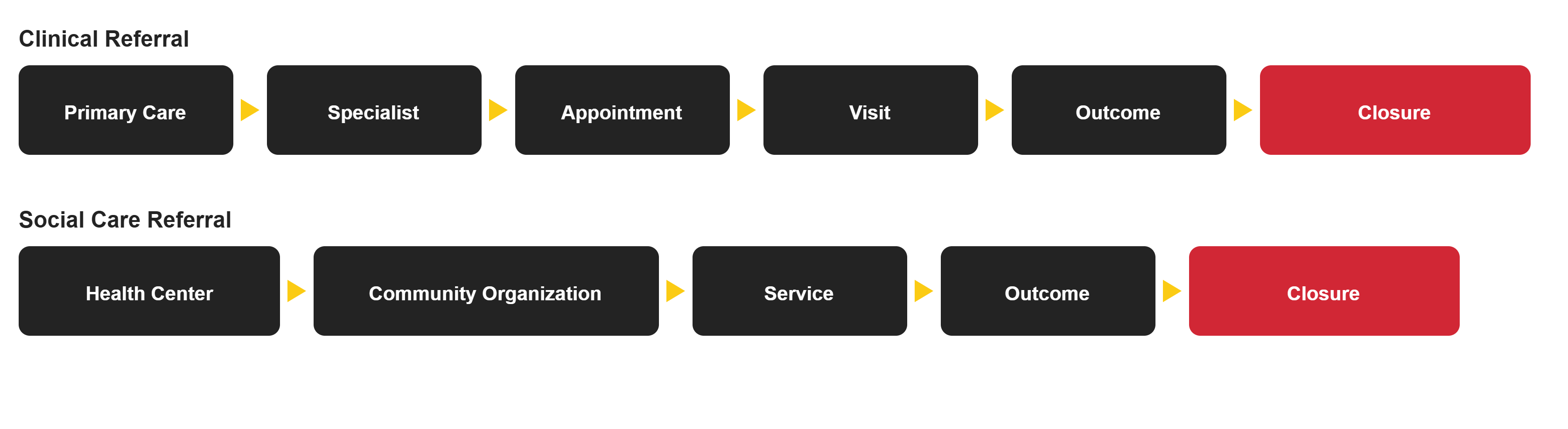
A connected referral management model provides visibility across both workflow types. This is particularly important for organizations working across healthcare and community networks where the receiving organization may not use the same clinical system as the referring organization.
What Referral Management Software Should Track
Healthcare organizations evaluating referral management software should look beyond referral creation. A complete referral management workflow should provide visibility into:
| Referral Stage | What to Track |
|---|---|
| Creation | Referral reason, patient, provider, service |
| Validation | Required and missing information |
| Eligibility | Payer, network, benefits, requirements |
| Matching | Provider, specialty, location, service |
| Routing | Destination and routing status |
| Acceptance | Accepted, declined, returned for information |
| Scheduling | Appointment availability and status |
| Patient outreach | Contact and communication activity |
| Visit | Scheduled, completed, no-show |
| Outcome | Referral result and follow-up |
| Closure | Completion status |
| Reporting | Referral volume, delays, outcomes, exceptions |
This changes referral management from a series of disconnected tasks into a measurable workflow.
Measuring Referral Performance
Once referral workflows are structured, healthcare organizations can measure more than referral volume. Useful referral management metrics can include:
- Referral Volume — How many referrals are created during a defined period?
- Acceptance Rate — Percentage of referrals accepted by receiving organizations.
- Decline Rate — Percentage of referrals declined by receiving organizations.
- Rerouting Rate — How often does a referral require an alternative provider?
- Time to Acceptance — How long does it take for the receiving organization to respond?
- Time to Appointment — How long does it take to schedule the requested service?
- Appointment Completion Rate — Percentage of scheduled referrals that result in completed visits.
- Referral Closure Rate — Percentage of referrals that reach the configured completion state.
- Outstanding Referrals — How many referrals remain open?
- Outcome Availability — Percentage of completed referrals with the required result or documentation available.
These measurements help organizations identify bottlenecks and improve referral workflows over time.
How GridSocial Supports Closed-Loop Referral Management
GridSocial by SocialRoots.ai supports clinical and social care referral workflows across the referral lifecycle.
The platform supports the following capabilities:
- Referral Creation: Create referrals with relevant patient, provider, service, clinical, insurance, and priority information.
- Referral Validation: Validate required information before the referral moves forward.
- Provider Matching: Identify providers based on specialty, service, location, mileage, network, and configured referral requirements.
- Automated Referral Routing: Route referrals according to configured rules and organizational preferences.
- Referral Acceptance and Rejection: Allow receiving organizations to accept, decline, or return referrals and capture relevant status information.
- Alternative Provider Routing: Automatically reroute referrals when the original provider cannot fulfill the requested service, without requiring staff to rebuild the referral manually.
- Appointment Coordination: Support appointment availability and scheduling directly within the platform.
- Patient and Provider Communication: Support communication and notifications around referral activity and scheduling.
- Appointment and Visit Tracking: Track referral progress through appointment and visit completion.
- Referral Outcomes: Capture relevant referral and service outcomes.
- EHR Integration: Support EHR-connected referral workflows, including production integrations with supported EHR systems.
- Status and Outcome Updates: Maintain visibility into referral progress and relevant completion information.
- Closed-Loop Referral Completion: Keep referrals active until configured workflow requirements are met, providing a structured path from referral creation through completion.
- Clinical + Social Care Referral Management: Extend referral workflows across healthcare providers and community partners, allowing organizations to coordinate both clinical and social care referrals.
From Referral Management to Referral Orchestration
The next generation of referral management is not simply about replacing fax with digital transmission. It is about coordinating the workflow that follows the referral.
A modern referral orchestration model connects:
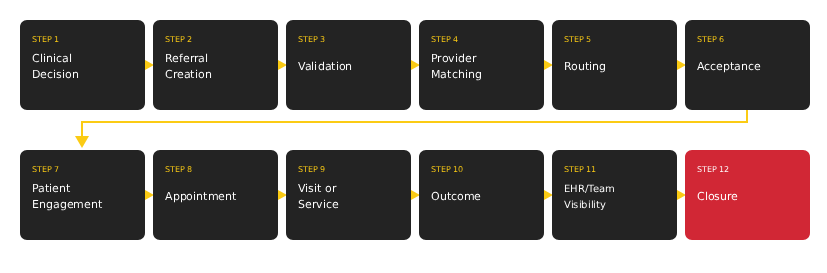
Each stage represents an opportunity to improve visibility, reduce manual coordination, and identify exceptions before they become unresolved referrals.
The technology should not replace clinical judgment. It should support the operational work surrounding the clinical decision.
Frequently Asked Questions
Closed-loop referral management is a process for tracking a referral from initiation through completion and ensuring that relevant status and outcome information is communicated back to the referring organization.
Referral tracking focuses on monitoring where a referral is in its lifecycle. Referral management encompasses the broader process, including referral creation, validation, provider matching, routing, acceptance, scheduling, follow-up, outcome capture, and closure.
Referral closure confirms that the required next step in care was completed and that relevant information was returned to the referring organization.
Referral orchestration coordinates the multiple steps that occur between referral creation and completion, including provider selection, routing, acceptance, scheduling, patient communication, outcome capture, and closure.
Depending on the platform and integrations available, referral management workflows can support information exchange across different healthcare technology environments. Interoperability frameworks such as 360X address electronic referral exchange between disparate health IT environments, including referral requests, status updates, and outcomes.
Yes. Referral management workflows can be extended beyond clinical providers to community organizations and social service providers. The specific capabilities depend on the platform, participating organizations, and workflow configuration.
Key capabilities include referral creation, validation, provider matching, routing, acceptance and rejection management, appointment coordination, status tracking, outcome capture, reporting, EHR integration, notifications, and closed-loop completion.
The Future of Healthcare Referrals Is Closed-Loop
For years, the referral process has been judged by a single milestone: was it sent? That milestone made sense when transmission itself was the hard problem, when fax machines and manual data entry were the bottleneck. That problem is largely solved.
The harder problem is what happens next, and it's the one most referral workflows still don't answer well.
That's the real difference between referral transmission and referral orchestration. Transmission moves information. Orchestration moves the patient through acceptance, scheduling, the visit, the outcome, and back to the referring care team, and gives staff visibility into where things stand at every stage.
Healthcare organizations don't need more ways to send referrals. They need referral workflows that stay open until the loop actually closes.
GridSocial by SocialRoots.ai supports that approach, connecting clinical and social care referral workflows across creation, routing, tracking, outcomes, and completion.
A referral isn't successful because it was sent. It's successful when the patient moves forward in care, and the care team knows what happened.
Ready to Close the Loop on Every Referral?
Give care teams visibility from referral creation through scheduling, service delivery, outcome capture, and resolution. GridSocial by SocialRoots.ai helps healthcare organizations coordinate clinical and social care referrals through a connected, trackable workflow.
Explore GridSocial's Closed-Loop Referral System or Contact SocialRoots.ai to see how your organization can improve referral visibility, follow-up, and closure.