How AI Can Transform the Medical Referral Workflow
Medical referral management is a critical part of coordinated healthcare delivery. A referral connects a patient with the appropriate specialist or service, transfers relevant clinical information, supports appointment coordination, and creates a pathway for follow-up care.
Yet a referral is rarely a single transaction.
Once a referral is initiated, healthcare teams may need to verify information, review documentation, identify the appropriate destination, coordinate scheduling, communicate with patients, monitor progress, receive specialist results, and ensure that the referring organization receives the information it needs for follow-up.
For large healthcare organizations, this creates a substantial operational challenge. VA Health Systems Research describes specialty-care referrals as numbering more than 25 million yearly across the VA healthcare system and identifies the patient, primary care provider, and specialist as the most direct participants in specialty-care referral coordination. (VA Health Systems Research, Measuring and Improving Specialty Care Coordination in VA, CDA 15-070)
This is where AI referral management can provide value.
Rather than replacing clinicians or making independent decisions about patient care, AI can support referral teams by processing information, identifying workflow gaps, surfacing exceptions, and helping staff manage large referral queues more efficiently.
The result is a more connected healthcare referral workflow, where technology supports the people responsible for coordinating care.

The Opportunity for AI in Medical Referral Management
A medical referral involves considerably more than submitting an order.
A typical process may involve:
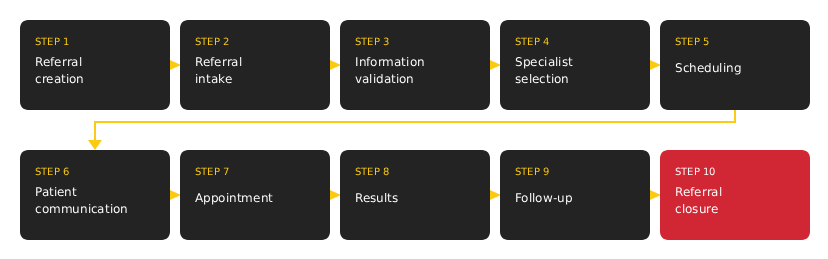
At each stage, delays or missing information can interrupt the process.
For example, a referral may arrive without required clinical documentation. A scheduling request may remain unresolved. A patient may not respond to an outreach attempt. A specialist may complete the consultation, but the results may not reach the referring organization.
These situations create additional work for referral coordinators and can make it difficult to determine which referrals require immediate attention.
For health centers providing services through formal referral arrangements, Chapter 4 of HRSA's Health Center Program Compliance Manual expects those arrangements, at a minimum, to address the manner by which referrals will be made and managed, and the process for tracking and referring patients back to the health center for appropriate follow-up care, for example, exchange of patient record information and receipt of lab results. (HRSA, Health Center Program Compliance Manual, Chapter 4: Required and Additional Health Services)
This makes medical referral management a strong candidate for carefully designed workflow automation.
AI can assist referral teams with tasks such as:
- Processing incoming referral information
- Extracting relevant information from referral documents
- Identifying missing or incomplete information
- Organizing referral documentation
- Categorizing referrals according to established workflows
- Surfacing referrals that require attention
- Monitoring referral status
- Identifying stalled or overdue workflow steps
- Supporting patient outreach workflows
- Flagging missing specialist results
- Helping teams prioritize administrative work
The purpose is not to automate clinical judgment.
Instead, AI can reduce repetitive information-management tasks so that referral coordinators and healthcare professionals can spend more time addressing cases that require human intervention.
Improving Referral Coordination
Effective referral coordination can directly influence how efficiently patients move from primary care to specialty care.
In a sleep medicine pilot at VA Puget Sound Medical Center, a referral coordination team redesigned the initial consultation process by shifting portions of referral management from specialist providers to registered nurses and integrating administrative support staff. Patients whose consults were completed by the referral coordination team were more likely than matched patients in the traditional specialist-led process to have an appointment date within 28 days of referral (33% vs. 12%) and to have the appointment scheduled within seven days (35% vs. 7%). Investigators also estimated that the approach could allow VA Puget Sound to accommodate approximately 4,800 additional visits, valued at $420,368. (VA Health Systems Research, Referral Coordination Team Improves Timeliness of VA Specialty Care Delivery and Patient Experience, February 2021)
These findings illustrate how redesigning referral coordination can improve specialty-care access and make more effective use of available clinical capacity. AI-enabled referral management can build on the same operational principle by helping teams identify incomplete, delayed, or stalled referrals that require staff attention.
For example, an AI-enabled system could continuously monitor referral records and identify cases where:
- A referral has not been scheduled
- Required information is missing
- A patient has not completed a required action
- A referral has remained in the same status for too long
- Specialist documentation has not been received
- Follow-up is required from the referring organization
Instead of requiring staff to review every referral manually, the system can surface the referrals that need attention.
AI-Powered Referral Workflow
An AI-powered medical referral management system can introduce intelligence across multiple stages of the referral lifecycle.
A simplified workflow could look like this:

1. Referral Intake
AI can help process information received through referral forms, electronic systems, documents, or other approved channels.
The system can organize referral information and identify relevant fields for downstream workflow processing.
2. Information Validation
Incomplete referrals can create delays.
AI can help identify missing information based on predefined organizational requirements and flag referrals that require additional documentation.
For example:

This allows staff to address incomplete referrals earlier rather than discovering the problem later in the process.
3. Workflow Identification
Different referrals may require different operational workflows.
An AI system can help classify incoming referrals according to predefined rules, specialty, referral type, urgency indicators, required documentation, or organizational workflow criteria.
Importantly, classification should operate within approved protocols rather than independently determining clinical treatment.
4. Scheduling Coordination
Once a referral is ready for scheduling, AI can help identify outstanding scheduling tasks and surface referrals that have not progressed.
The system can provide visibility into:
- Pending scheduling
- Scheduling attempts
- Appointment status
- Patient outreach
- Rescheduling requirements
- Unresolved scheduling exceptions
5. Referral Monitoring
Referral management should not end when the referral is sent.
The system can continuously monitor referral status and identify cases that remain unresolved.
This shifts from passive tracking to proactive management.
6. Follow-Up and Closure
After specialist care occurs, the referring organization may need consultation notes, test results, or other information.
AI can help identify referrals where expected information has not yet been received and surface them for staff follow-up.
This supports a more complete closed-loop process.
From Healthcare Workflow Automation to Intelligent Coordination
Healthcare workflow automation is most valuable when it addresses repetitive operational work while preserving human oversight.
Traditional automation generally follows predefined rules:
If X happens → perform Y
AI can extend this model by helping teams interpret information and identify patterns within established workflows.
For example:
Traditional automation:
Referral status = pending → Send reminder
AI-assisted workflow:
- Referral remains pending
- Appointment has not been scheduled
- required documentation is complete
- previous outreach attempt unsuccessful → Surface referral as an exception for coordinator review
The difference is not that AI independently makes the care decision.
The difference is that AI can help identify which cases require attention.
A responsible approach combines:
AI assistance + defined workflows + human oversight + monitoring
This model is particularly important in healthcare because referral workflows can contain clinical information, patient-specific circumstances, organizational policies, and decisions that require professional judgment.
Maintaining Visibility Across the Referral Lifecycle
One of the most important capabilities of an intelligent referral platform is visibility.
Without centralized tracking, referral teams may need to search across multiple systems, spreadsheets, inboxes, messages, and EHR records to determine a referral's current status.
That makes it difficult to answer basic operational questions:
- Has the referral been received?
- Is the referral complete?
- Has it been scheduled?
- Has the patient been contacted?
- Did the appointment occur?
- Were results received?
- Does the referring provider have the necessary information?
- Does the patient require follow-up?
HRSA's Health Center Program Site Visit Protocol reinforces this lifecycle approach: for services provided through formal referral arrangements, reviewers assess how referrals are made and managed and how patients are tracked and referred back to the health center for follow-up care, including through review of sampled patient records. (HRSA, Health Center Program Site Visit Protocol, Chapter 2: Required and Additional Health Services)
An intelligent healthcare referral workflow can support this lifecycle with a centralized view:
Receive → Validate → Coordinate → Schedule → Monitor → Identify exceptions → Follow up → Close
This is fundamentally different from:
Create → Send → Wait
The first model treats referral management as an ongoing operational process rather than a single transaction.
Identifying Referral Exceptions
One of the strongest applications for AI is exception management.
Healthcare organizations may have thousands of active referrals at any given time. Manually checking each referral at regular intervals can consume significant staff time.
AI can help identify referrals that deviate from expected workflow patterns.
Potential exceptions include:
- Missing Information: A referral may be missing documentation required before scheduling or processing can continue.
- Scheduling Delays: A referral may remain unscheduled beyond the organization's defined timeframe.
- Patient Outreach Issues: Repeated outreach attempts may not result in patient contact.
- Missing Results: The specialist visit may have occurred, but the expected consultation documentation or results may not have returned.
- Incomplete Follow-Up: A referral may technically be completed while an expected follow-up action remains outstanding.
These cases can be surfaced as exceptions for referral coordinators.
The objective is simple:
Don't make staff search for problems. Surface the problems that need staff attention.
The Role of AI in a Human-Centered Workflow
AI should complement, not replace, healthcare professionals.
Referral management involves more than information processing. Staff may need to consider patient circumstances, specialist availability, organizational policies, communication barriers, insurance requirements, and clinical context.
For this reason, the most effective AI referral management approach is human-centered.
AI can handle information-intensive tasks such as:
- Document processing
- Status monitoring
- Workflow classification
- Exception identification
- Task generation
- Administrative follow-up prompts
Healthcare professionals remain responsible for decisions that require clinical or organizational judgment.
This creates a practical division of responsibility:
| AI can support | Healthcare professionals manage |
|---|---|
| Information processing | Clinical decisions |
| Referral status monitoring | Patient-specific judgment |
| Missing-information detection | Exceptions requiring interpretation |
| Workflow prioritization | Care decisions |
| Administrative reminders | Communication requiring professional judgment |
| Exception identification | Final actions and accountability |
This distinction is essential when implementing AI in healthcare environments.
Automating the Medical Referral Process Without Losing Control
The goal of automating the medical referral process should not be to remove people from the workflow.
It should be to remove unnecessary manual effort.
A poorly designed automation strategy may simply move manual work from one screen to another.
A better approach starts by identifying where referral teams spend time on repetitive tasks.
For example:
Manual process
- Coordinator opens referral
- Reviews documents
- Checks whether information is complete
- Updates status
- Checks scheduling
- Sends follow-up
- Reviews referral again
- Searches for specialist results
- Updates the record
- Closes referral
AI-assisted process
- Referral is received
- Information is processed
- Completeness is assessed against defined requirements
- Workflow status is updated
- Outstanding tasks are identified
- Exceptions are surfaced
- Coordinator reviews and acts
- Results are monitored
- Follow-up is triggered according to workflow rules
- Referral is closed when required steps are complete
The second model does not eliminate the coordinator.
It gives the coordinator a clearer view of where human action is needed.
Building a Closed-Loop Referral Workflow
An effective referral process should ultimately be closed-loop.
A closed-loop workflow means the organization can track the referral beyond the point at which it is sent and determine whether the expected next steps occurred.
This includes:
Referral initiated ↓ Referral received ↓ Information validated ↓ Specialist or service identified ↓ Appointment coordinated ↓ Patient receives care ↓ Results or documentation received ↓ Referring organization notified ↓ Follow-up completed ↓ Referral closed
This model aligns with HRSA expectations around referral management, patient tracking, and follow-up.
AI can help maintain visibility across these stages by identifying referrals that have stopped progressing.
For community health centers and other organizations managing formal referral arrangements, this visibility can also support operational documentation and compliance processes.
Measuring the Impact of AI Referral Management
Implementing AI without measuring outcomes makes it difficult to determine whether the technology is actually improving referral operations.
Organizations should establish baseline metrics before introducing automation.
Useful measures may include:
- Referral Processing Time: How long does it take to process an incoming referral?
- Time to Appointment: How long does it take from referral initiation to scheduled appointment?
- Referral Completion Rate: What percentage of referrals reach the expected completion stage?
- Referral Leakage: How many referrals fail to result in completed care or leave the organization's preferred network?
- Missing Information Rate: How frequently do referrals require additional documentation?
- Outstanding Referral Volume: How many referrals remain unresolved at a given time?
- Follow-Up Completion: How consistently are required follow-up actions completed?
- Staff Workload: How much coordinator time is spent on repetitive referral administration?
These metrics can help organizations determine whether AI is reducing operational friction while maintaining appropriate oversight.
Challenges to Consider Before Implementing AI
AI referral management should not be treated as a plug-and-play solution.
Healthcare organizations should consider several factors before implementation.
- Data Quality: AI systems depend on the quality and consistency of the information they process. Incomplete, inconsistent, or poorly structured referral data can reduce automation value.
- Integration: Referral workflows often span EHRs, scheduling systems, provider directories, communication tools, and other applications. An AI solution should fit into the existing technology environment rather than create another isolated workflow.
- Privacy and Security: Referral information may contain sensitive patient data. Organizations should evaluate security controls, access management, auditability, data handling, and applicable regulatory requirements.
- Human Oversight: Organizations should review AI-generated recommendations, classifications, or alerts according to policies and risk levels.
- Workflow Governance: Organizations need clear rules for escalation, exception handling, ownership, and accountability.
The technology is only one component of successful referral management.
The Future of Medical Referral Management
The future of automating the medical referral process is not simply about replacing manual tasks. It is about creating a workflow that understands a referral's current state, identifies outstanding actions, and helps teams respond before delays become larger problems.
With more than 25 million specialty-care referrals yearly across the VA healthcare system, improving referral coordination at scale has significant operational impact. (VA Health Systems Research, CDA 15-070)
AI can provide the intelligence layer needed to make referral workflows more proactive, transparent, and actionable.
The goal is not simply to send a referral successfully. The goal is to ensure that the referral moves efficiently from initiation to specialist care and appropriate follow-up.
What Healthcare Organizations Should Look for in an AI Referral Management Platform
Organizations evaluating an AI-enabled referral solution should consider capabilities across the complete referral lifecycle.
Key capabilities include:
- Centralized referral intake
- Referral status tracking
- Workflow automation
- Missing-information detection
- Referral prioritization
- Exception management
- Appointment coordination
- Patient outreach support
- Specialist communication
- Results tracking
- Closed-loop referral tracking
- EHR integration
- Audit trails
- Role-based access
- Reporting and analytics
- Human review and escalation workflows
The most important question is not:
"Does the platform use AI?"
Instead, healthcare organizations should ask:
"Does the platform help us move referrals from initiation to completed care with greater visibility, consistency, and accountability?"
That is the real measure of an AI-enabled referral management solution.
Conclusion
Medical referrals are a critical connection between primary care, specialty care, community services, and patients. As referral volumes and healthcare coordination requirements grow, organizations need more than systems that simply create and send referrals.
They need visibility across the entire referral lifecycle.
Evidence from a VA pilot shows that structured referral coordination can improve appointment timeliness and increase operational capacity. HRSA's Health Center Program requirements likewise emphasize how referrals are made and managed and how patients are tracked back to the health center for appropriate follow-up.
AI referral management can build on these principles by helping healthcare organizations process referral information, identify missing data, monitor workflow progress, surface exceptions, and support referral coordinators.
The goal is not to replace healthcare professionals.
It is to give them better visibility and reduce the repetitive administrative work that can slow down referral coordination.
The future of the healthcare referral workflow can therefore be summarized as:
Traditional: Create → Send → Manually track → Follow up
Automated: Create → Validate → Route → Track → Notify → Follow up
AI-assisted: Understand → Validate → Coordinate → Monitor → Identify exceptions → Act → Complete
The ultimate objective is simple: help every referral move efficiently from initiation to appropriate care and follow-up while keeping healthcare professionals in control.
Learn More About Intelligent Referral Management
Healthcare organizations looking to modernize referral coordination can explore GridSocial by SocialRoots.ai, a closed-loop referral management platform designed to help organizations coordinate referrals, track patient progress, and improve visibility across the referral lifecycle.