Hospital vs. FQHC Policy Management: Key Differences & Software Needs
Hospital policy management software and FQHC policy management software are often discussed as if they serve the same purpose. In practice, they operate within fundamentally different compliance frameworks.
Choosing software built for a different compliance framework doesn't just create a poor fit—it creates work. Configuration, restructuring, workarounds. That burden is worth understanding before you evaluate.
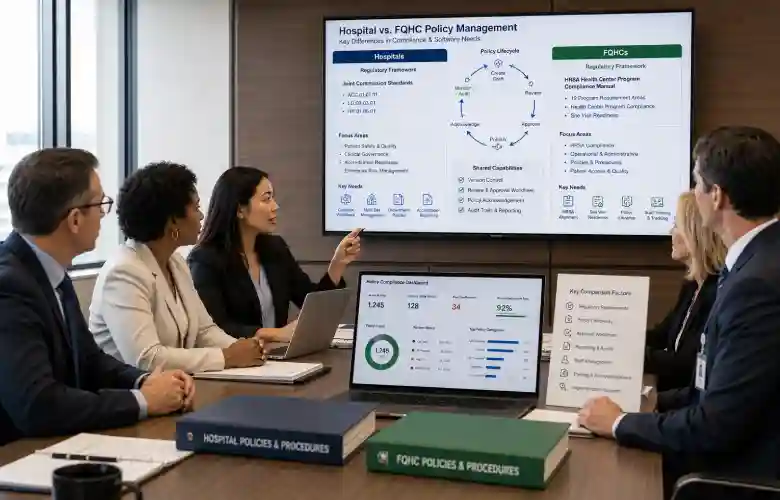
Two Different Compliance Frameworks
Hospitals operate primarily under Joint Commission accreditation standards, CMS Conditions of Participation, and HIPAA frameworks designed for acute care environments with large, departmentalized structures.
FQHCs and Look-Alikes operate under the HRSA Health Center Program Compliance Manual, a federal framework that covers 19 program requirements specific to community health center operations. These areas include governance, sliding-fee discount, project scope, credentialing, quality improvement, and health IT, each with distinct policy documentation requirements assessed during an Operational Site Visit.
The two frameworks share some common ground. Both require current policies, staff acknowledgment, and documented procedures. But the organizational structure, regulatory references, and audit process are meaningfully different.
Key Differences at a Glance
| Policy Management Area | Hospital | FQHC / Look-Alike |
|---|---|---|
| Governing framework | Joint Commission / CMS CoP / HIPAA | HRSA Health Center Program Compliance Manual |
| Policy organization | By department or service line | By HRSA program requirement area / module |
| Primary audit | Joint Commission survey / CMS inspection | HRSA Operational Site Visit (OSV) |
| Review cycle driver | Accreditation calendar | HRSA compliance calendar + annual reporting |
| Acknowledgment tracking | Often department-managed | Organization-wide with exportable audit records |
| Look-Alike requirements | Not applicable | Same 19 HRSA requirements as FQHCs |
| Software configuration | Built-in for hospital workflows | Requires custom setup unless FQHC-specific |
What Hospital Policy Management Software Does Well
Many policy management platforms were originally built for hospital systems and later adapted for broader healthcare use. FQHCs evaluating software frequently encounter products optimized around accreditation surveys, departmental policy structures, and hospital governance models.
These capabilities are real—but they don't automatically translate into HRSA readiness.
What FQHCs and Look-Alikes Actually Need from Policy Software
The FQHC compliance environment has specific software requirements that hospital-focused platforms were not designed to meet.
- HRSA Compliance Manual chapter mapping built into the policy library structure.
- Review cycles tied to HRSA annual reporting timelines and OSV preparation schedules.
- Staff acknowledgment tracking with exportable documentation for site visit preparation.
- Support for Look-Alike designation requirements alongside standard FQHC compliance.
- Sliding fee discount, scope of project, and governance policy categories as standard modules.
- Real-time compliance dashboard organized by HRSA module, not hospital department.
These capabilities reflect a fundamentally different way of organizing compliance documentation—one that FQHC-specific platforms are built around by design.
How to Evaluate Policy Software as an FQHC
When FQHCs and Look-Alikes evaluate policy management platforms, a few straightforward questions clarify fit quickly:
- Does the platform organize policies by the HRSA module out of the box?
- Are review cycles configurable to HRSA compliance timelines, not just generic annual schedules?
- Does it support staff acknowledgment tracking with audit-ready export?
- Is Look-Alike designation documentation supported in the standard workflow?
- Does the vendor have direct experience with HRSA compliance requirements?
- Can the platform produce documentation organized by HRSA program requirements without manual restructuring?
A hospital policy management platform that requires a yes to each of these questions through custom configuration is a different investment than one that delivers them by design.
Purpose-Built vs. Adapted: What the Difference Looks Like in Practice
Platforms built for hospitals require configuration to become HRSA-ready. That configuration burden—mapping policies to HRSA modules, restructuring dashboards by program requirement, building OSV-ready documentation workflows—sits with your team.
ComplAiance360 approaches the problem differently. HRSA module mapping, governance and sliding fee categories, and OSV documentation workflows are standard features. The compliance framework is the foundation of the system, not something added through configuration.
| Adapted Hospital Software | FQHC-Specific Software |
|---|---|
| Requires custom HRSA module mapping | HRSA modules built in |
| Generic policy categories | Sliding fee, governance, scope preconfigured |
| Manual OSV preparation | OSV-ready reporting standard |
| Department-focused dashboards | HRSA compliance dashboards |
Frequently Asked Questions
Yes, but most hospital platforms require significant configuration to align with HRSA program requirements. The question isn't whether it's possible—it's how much of that work lands on your team.
Yes. Look-Alikes are held to the same 19 HRSA Health Center Program requirements as FQHCs, including governance, sliding fee discount, and scope of project documentation.
HRSA reviewers assess documentation across all 19 Health Center Program requirements. Software that organizes policies by HRSA module can make evidence collection more straightforward than systems structured around hospital departments or accreditation categories.
At minimum: HRSA module-mapped policy library, review cycles tied to compliance timelines, staff acknowledgment tracking with exportable records, and Look-Alike designation support.
Explore Policy Management Built for Health Centers
See how ComplAiance360 maps policies directly to HRSA program requirements—so your team is OSV-ready without manual restructuring.
Visit Socialroots.ai to see how purpose-built policy management supports FQHCs and Look-Alikes across every HRSA program requirement area.
Continue Reading:
→ Policy, Document & Contract Management for FQHCs: The Complete Guide
→ Healthcare Document Management Software: Features Every FQHC Should Demand |