Behavioral Health Referral Management for Mental Health and SUD Care: Connecting 86.6 Million Lives
American behavioral health is in the middle of its most exciting transformation in a generation. Federal investment is expanding, provider networks are growing, and connected, compassionate care is reaching more people than ever before. At the center of that progress is a quiet but powerful capability: behavioral health referral management - the operational layer that turns a recommendation into a real, measurable connection to care.
According to SAMHSA's 2024 National Survey on Drug Use and Health (NSDUH), 33% of U.S. adults - approximately 86.6 million people - experienced any mental illness (AMI) or a substance use disorder (SUD) in the past year. That's 86.6 million Americans whose lives can be measurably better when their care is connected, their referrals close, and their providers work as a true network. For federally qualified health centers (FQHCs), Certified Community Behavioral Health Clinics (CCBHCs), community mental health centers, and county behavioral health authorities, modern behavioral health referral management is no longer optional - it's foundational.
Mental Health and Substance Use Disorder in America: 2024 NSDUH Data
The most recent SAMHSA data shows real, measurable momentum in connecting Americans to behavioral health care:
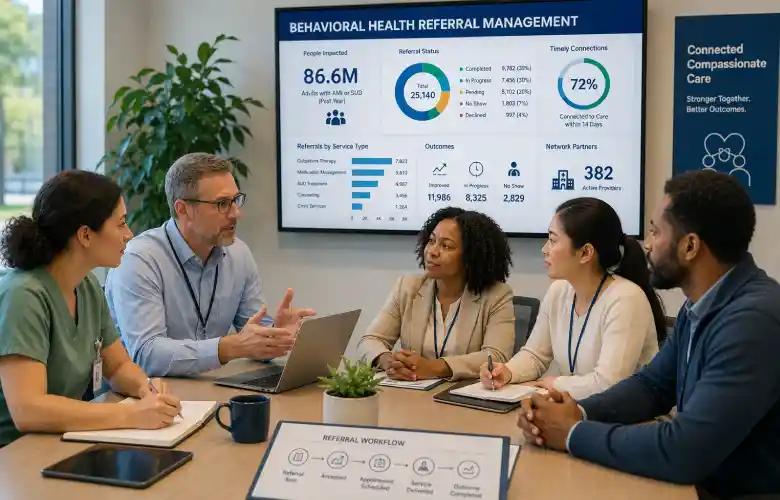
- 86.6 million U.S. adults (33% of adults) had any mental illness (AMI) or a substance use disorder (SUD) in 2024.
- 14.6 million adults had serious mental illness (SMI), and 70.8% received mental health treatment.
- 32 million adults with any mental illness connected to care in the past year.
- 1 in 5 people who needed substance use treatment received it, with adolescents leading at over 30%.
- Adolescent depression dropped from 20.8% in 2021 to 15.4% in 2024 - a meaningful sign of progress.
Behind every percentage point is a person whose provider, family, and community made it happen. Each of those numbers can move further in the right direction with stronger behavioral health care coordination - which is exactly where modern referral management comes in.
How Behavioral Health Referral Management Strengthens Care Coordination
Behavioral health referral management helps healthcare organizations coordinate referrals across mental health, substance use disorder (SUD), and community service providers from identifying a need to confirming a successful connection to care. Modern systems use closed-loop referrals to track scheduling, engagement, and outcomes, creating greater visibility and accountability throughout the care journey.
For organizations serving individuals with serious mental illness (SMI), SUD, or co-occurring conditions, behavioral health referral management helps ensure every referral receives the attention it deserves. Care teams can monitor progress, collaborate more effectively with partners, and support individuals through connected, coordinated care experiences.
By providing a shared view of referral activity across providers and community organizations, closed-loop referral management strengthens care coordination, improves patient engagement, and helps organizations deliver better outcomes across the behavioral health continuum.
Federal Programs Driving Coordinated Behavioral Health Care
Three national initiatives are accelerating coordinated care for SMI and SUD populations. CCBHC care coordination is reaching the country: research published in JAMA Health Forum shows more than half of the U.S. population now lives within a CCBHC service area, and starting in 2025 all CCBHCs must report on standardized quality measures, making documented coordination a real advantage. The 988 Suicide & Crisis Lifeline is becoming a household number, with The Pew Charitable Trusts reporting that wait times have decreased every year, and SAMHSA is now funding 988 follow-up referral coordination programs to link callers to ongoing community care. Medicaid Section 1115 waivers are unlocking new pathways, from contingency management for substance use disorder care coordination to pre-release coverage for justice-involved individuals, expanding the partner network and the opportunity to demonstrate impact.
Building Stronger Care Connections with GridSocial
American behavioral health is increasingly a story of expanding access, growing networks, and maturing care coordination. What makes the difference between a referral that helps and a referral that fades is almost always what happens after the first conversation. Closed-loop referrals for behavioral health were built for exactly that moment.
Healthcare organizations investing in modern behavioral health referral management are building stronger systems for coordination, visibility, and accountability, keeping providers and community partners aligned throughout the patient journey and reducing the chance that patients fall through gaps in care.
GridSocial by SocialRoots.ai delivers behavioral health referral management built for FQHCs, CCBHCs, and community partners, helping organizations track referrals, monitor outcomes, and maintain continuity across mental health, substance use treatment, and community services. The 86.6 million Americans navigating mental health and substance use needs deserve a system that connects, coordinates, and cares - one referral at a time.
Ready to strengthen behavioral health referral management for the populations you serve?
Explore GridSocial's Closed-Loop Referral System
Sources
- SAMHSA - Results from the 2024 National Survey on Drug Use and Health (NSDUH), released July 28, 2025
- SAMHSA - Managing Life with Co-Occurring Disorders
- JAMA Health Forum - Mauri et al., Proportion of US Counties and Population Served by Certified Community Behavioral Health Clinics, 2024
- The Pew Charitable Trusts - 3 Years of the 988 Suicide & Crisis Lifeline: What's Next? (2025)
- CMS / Medicaid.gov - Certified Community Behavioral Health Clinic (CCBHC) Demonstration


