Value-Based Care Software: Complete Guide to Platforms, Features & Benefits
Value-based care software helps healthcare organizations connect patient data, risk, quality, care coordination, utilization, cost, and performance management.
Instead of focusing only on services delivered, value-based care looks at outcomes, quality, patient experience, utilization, and, depending on the arrangement, total cost of care.
For providers, health systems, ACOs, health plans, FQHCs, and physician groups, the objective is simple:
Turn data into action, coordinate the right care, and measure the result.
Key Takeaways
- Value-based care software connects patient data, risk, care gaps, quality, utilization, cost, and performance in one broader workflow.
- Risk stratification and care-gap management help teams identify patients who need attention and determine the right next action.
- Care coordination and referral management help turn identified needs into completed care by connecting patients with providers and tracking referral progress and outcomes.
- Value-based care combines clinical and financial performance, including quality measures, utilization, total cost of care, and contract performance.
- The goal is to connect data to action and measurable outcomes, from identifying a patient need to coordinating care and confirming what happened.
What Is Value-Based Care Software?
Value-based care software helps organizations manage patient populations, identify risk and care gaps, coordinate interventions, monitor quality, analyze utilization, and measure clinical and financial performance.
It may bring together information from:
- EHRs
- Claims
- Clinical systems
- Utilization data
- Referral systems
- Social-needs data
- Payer and contract data
A traditional clinical system may document what happened during an encounter.
A value-based care platform helps answer broader questions:
- Which patients need attention?
- What care are they missing?
- Which patients are at greatest risk?
- Are interventions improving outcomes?
- How are quality and costs performing?
- Are value-based contracts meeting their targets?
Why Healthcare Organizations Need Value-Based Care Software
Value-based care requires visibility beyond individual encounters.
Organizations may need to understand:
- Patient risk
- Care gaps
- Quality
- Utilization
- Care coordination
- Patient outcomes
- Total cost of care
- Contract performance
That information is often spread across EHRs, claims systems, payer platforms, provider networks, and community organizations.
Value-based care software connects these data and workflows, helping organizations shift from reactive care to proactive population and performance management.

Value-Based Care at Scale
Value-based and accountable care already operate at a significant scale.
As of January 2026, CMS estimated that 14.3 million Medicare beneficiaries were receiving care coordinated through Medicare ACO initiatives. The Medicare Shared Savings Program included 511 ACOs serving approximately 12.6 million Traditional Medicare beneficiaries.
CMS holds ACOs accountable for factors including quality, cost, and experience of care.
That creates a need to connect:

How Value-Based Care Software Works
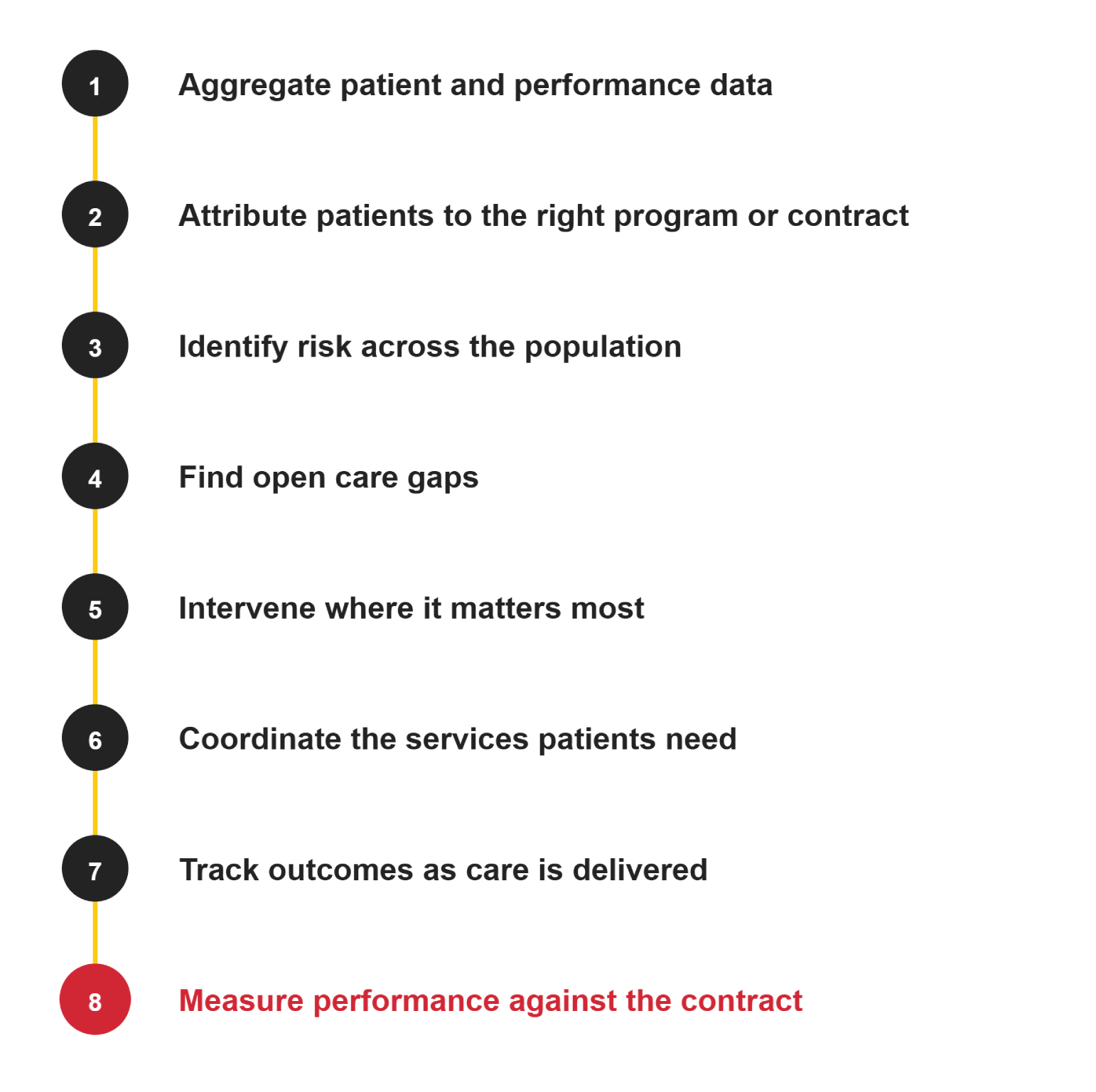
A typical workflow begins by combining relevant patient and performance information.
The platform can then identify:
- High-risk patients
- Open care gaps
- Rising utilization
- Preventive-care opportunities
- Follow-up needs
- Quality-performance gaps
Care teams can prioritize interventions, coordinate services, and track results.
At the organizational level, the same data can support quality, utilization, cost, and contract-performance analysis.
A simplified workflow is:
Key Capabilities of Value-Based Care Software
Important capabilities may include:
Data Aggregation and Interoperability
Bring together relevant information from EHRs, claims, clinical systems, payer systems, and other sources.
Patient Attribution
Identify which patients belong to a provider, ACO, payer arrangement, or value-based contract.
Risk Stratification
Prioritize patients based on clinical conditions, utilization, care gaps, and other relevant risk factors.
Care Gap Management
Identify missed screenings, follow-ups, preventive services, and other intervention opportunities.
Care Coordination and Referral Management
Connect patients with specialists, behavioral health providers, post-acute care, and community services.
Quality and Utilization Management
Monitor applicable quality measures, emergency department use, admissions, readmissions, and other utilization patterns.
Cost and Contract Performance
Analyze total cost of care, benchmarks, financial performance, and results across value-based arrangements.
Analytics and Reporting
Give teams visibility into population, provider, quality, utilization, financial, and operational performance.
The capabilities should work together.
A risk score matters when it leads to action, and an intervention matters when you can measure its outcome.
Risk Stratification and Care Gaps
Not every patient requires the same level of intervention.
Risk stratification can consider factors such as:
- Chronic conditions
- Hospitalizations
- Emergency department use
- Claims history
- Care gaps
- Clinical history
- Social needs
The objective is not simply to create a score.
It helps care teams decide who needs attention and what should happen next.
The same principle applies to care gaps.
A patient may have:
- An overdue screening
- Missing chronic-care follow-up
- An incomplete specialist referral
- A missing post-discharge appointment
- Another recommended service that was never completed
A useful workflow is:

Care Coordination and Referral Management
Identifying a need does not mean the patient received the required care. Patients may require services across primary care, specialty care, behavioral health, hospitals, post-acute care, home-based services, and community organizations.
Referral management coordinates these services by connecting patients with appropriate providers, tracking referral progress, and documenting whether the requested service was completed. This creates greater visibility into care gaps and helps organizations demonstrate that identified patient needs were addressed.
This is where referral management intersects with value-based care. Closed-loop referral management provides evidence that a referral moved beyond identification and resulted in a completed service or documented outcome.
Social Determinants of Health and HRSN
Clinical care is only one part of health.
Individual health-related social needs (HRSN) may include:
- Food insecurity
- Housing instability
- Transportation barriers
- Financial strain
- Difficulty accessing healthcare
These barriers can affect whether a patient follows a care plan.
Value-based care workflows can therefore connect:

The important step is moving from knowing a need exists to coordinating a response.
Quality, Utilization and Financial Performance
Value-based care combines clinical and performance management.
Organizations may need to monitor:
Quality
- Preventive care
- Chronic-condition management
- Patient outcomes
- Patient experience
- Readmissions
- Program-specific measures
Utilization
- Emergency department visits
- Hospital admissions
- Readmissions
- Post-acute use
- Other contract-relevant utilization
Financial and Contract Performance
- Total cost of care
- Benchmarks
- Quality thresholds
- Shared savings
- Shared losses
- Financial risk
- Contract performance
The specific methodology depends on the payer and program.
The broader goal is to connect:
Clinical Performance + Quality + Utilization + Cost + Contract Rules
Benefits of Value-Based Care Software
Value-based care software does not guarantee better outcomes or lower costs, but it can help organizations pursue those goals more systematically.
Potential benefits include:
- Earlier identification of high-risk patients
- More systematic care-gap closure
- Better care coordination
- Greater visibility into quality
- Better utilization monitoring
- Stronger financial and contract visibility
- More actionable population management
Value-Based Care Software vs. Traditional Healthcare Software
| Traditional Healthcare Software | Value-Based Care Software |
|---|---|
| Focuses on individual encounters | Focuses on populations and outcomes |
| Documents care delivered | Tracks quality and performance |
| Data may remain system-specific | Aggregates data across sources |
| Reactive follow-up | Proactive risk and gap management |
| Limited population visibility | Population analytics |
| Primarily clinical operations | Connects clinical and financial performance |
Value-based care software does not replace the EHR.
The EHR remains central to clinical documentation, while value-based care technology adds population-level analytics, coordination, quality, utilization, and performance capabilities.
Value-Based Care vs. Population Health Software
The categories overlap significantly.
| Population Health | Value-Based Care |
|---|---|
| Population segmentation | Population segmentation |
| Risk stratification | Risk stratification |
| Care-gap management | Care-gap management |
| Population outcomes | Quality-program performance |
| Care management | Care management |
| Clinical utilization | Utilization and cost |
| Population analytics | Contract and financial analytics |
| May operate independently of payment models | Often supports value-based arrangements |
The key distinction is that value-based care often adds:
How is the population performing against defined quality, utilization, cost, or payment objectives?
Who Uses Value-Based Care Software?
Providers and Physician Groups
Manage care gaps, high-risk patients, services, quality, and performance.
Health Systems
Connect population data across facilities and providers while monitoring utilization and outcomes.
ACOs
Manage attributed populations, quality, utilization, cost, care coordination, and contract performance.
Health Plans
Analyze populations, identify risk, coordinate interventions, and monitor provider performance.
FQHCs and Community Health Centers
Coordinate clinical, behavioral health, specialty, and community services within value-based arrangements.
What Should Organizations Measure?
The right metrics depend on the program and contract.
Common measures may include:
- Risk distribution
- Care-gap closure
- Preventive-care completion
- ED utilization
- Hospital admissions and readmissions
- Referral completion
- Patient engagement
- Quality performance
- Patient outcomes
- Total cost of care
- Benchmark performance
- Shared savings or losses where applicable
The goal is not to measure everything. It is to connect measurement to decisions and actions.
How to Choose Value-Based Care Software
Evaluate whether the platform supports the organization's actual populations, programs, contracts, and workflows.
Ask:
Can It Use the Data We Need?
Review support for EHR, claims, utilization, payer, quality, and other required data.
How Does Attribution Work?
Understand how patients are assigned to providers, populations, and contracts.
Can It Identify Risk and Care Gaps?
The platform should clearly show who needs attention and why.
Can Insights Become Actions?
Teams should be able to move from identified risk or gaps to interventions, coordination, and completion.
Can It Measure Quality, Utilization and Cost?
Organizations with financial accountability need visibility beyond clinical outcomes.
Can It Support Multiple Contracts?
Different contracts may use different populations, measures, benchmarks, and methodologies.
Does It Integrate With the EHR?
Evaluate interoperability, workflow integration, and write-back where appropriate.
Is It Secure and Scalable?
Review HIPAA safeguards, access controls, auditability, integration security, scalability, and organizational requirements.
Where Referral Management Fits Into Value-Based Care
Referral management is one component of a broader value-based care strategy.
A typical pathway may be:
Patient Data → Risk Identified → Care Gap Identified → Service Needed → Referral → Completion → Outcome
The value-based care platform may identify the need.
The referral workflow helps act on it.
Without that coordination layer, an organization may know a patient needs care without knowing whether they actually received it.
How GridSocial Supports Value-Based Care Workflows
GridSocial by SocialRoots.ai supports the care-coordination and closed-loop referral layer within a broader value-based care strategy.
Identify the Service
Once a patient need or care gap is identified, GridSocial can support referral creation and validation.
Connect the Patient
GridSocial supports eligibility verification, provider matching, automated routing, provider acceptance and rejection, and alternative routing.
Coordinate Through Completion
Patient and provider outreach, appointment availability, scheduling, and visit tracking help move the referral forward.
Confirm the Outcome
Outcome capture, closed-loop completion, EHR write-back, and notifications help the referring team understand what happened.
The workflow can be summarized as:
Identify the Need → Connect the Patient → Complete the Service → Capture the Outcome
Frequently Asked Questions
Value-based care software helps organizations manage populations, risk, care gaps, quality, utilization, coordination, and clinical and financial performance.
Common capabilities include data aggregation, attribution, risk stratification, care-gap management, coordination, quality measurement, utilization analysis, cost analysis, contract management, and reporting.
It can support attributed populations, care gaps, quality, care coordination, utilization, cost visibility, and contract-performance reporting.
The categories overlap, but value-based care software typically emphasizes quality, program performance, utilization, cost, contracts, and financial accountability.
No. It generally works alongside EHRs and other healthcare systems.
Patient attribution links patients to a provider, ACO, payer arrangement, or value-based contract based on defined program rules.
Some arrangements do, while others focus primarily on quality incentives or other payment methodologies.
Referral management helps convert an identified patient need into coordinated care and provides visibility into whether the intended service was completed.
Conclusion: Connect Data, Care and Performance
Value-based care requires looking beyond individual encounters. The strongest platforms connect data to insight, insight to action, action to care, and care to measurable outcomes and performance.
Three questions anchor the work: which patients need attention, what action should we take, and did that action improve care and performance?
For organizations focused on closing gaps between referral, care coordination, and completed services, GridSocial helps connect these steps in a closed-loop workflow.