Healthcare Referral Platform: How to Improve Referral Management & Close the Loop
A healthcare referral platform helps organizations manage what happens after a referral is created by connecting referral intake, provider matching, routing, scheduling, tracking, and outcomes.
Sending a referral does not mean the patient received care. Referrals can stall because information is missing, the provider is unavailable or out of network, scheduling breaks down, or the referring team never receives the outcome.
The goal is not simply to send referrals.
It is to keep referrals moving, connect patients with the right care, and know what happened afterward.
Key Takeaways
- A healthcare referral platform connects referral intake, provider matching, routing, scheduling, tracking, and outcomes in one workflow.
- Referral visibility helps teams see whether a referral was accepted, scheduled, completed, or still needs action.
- Provider matching and alternative routing help handle network, location, availability, and referral rejection issues.
- Closed-loop referral management tracks the journey from referral creation through appointment, service delivery, outcome, and closure.
- Platforms can support both clinical and social care referrals, including behavioral health, transportation, food, and housing services.
- The right platform should work with existing workflows and EHR systems while supporting tracking, reporting, security, and compliance.
- Teams can measure referral performance through completion rate, referral leakage, time to appointment, and referral aging.
- The key goal is to know what happened after the referral was sent and whether the patient received the intended care.

Why Healthcare Referral Management Breaks Down
Referral management often crosses multiple people, organizations, and systems.
When those steps are disconnected, several problems can occur.
Limited Visibility After Sending
Staff may know that a referral was sent but not whether:
- The receiving provider received it
- The referral was accepted
- The patient was contacted
- An appointment was scheduled
- The patient attended
- The requested service was completed
This can create referral leakage and unnecessary manual follow-up.
Incomplete or Misrouted Referrals
Missing patient, clinical, insurance, or service information can delay processing.
Provider selection can also fail when factors such as specialty, network participation, geography, availability, or capacity are not considered.
A referral platform can validate information earlier and support more structured provider matching.
Scheduling and Patient Follow-Up Gaps
Even after a referral is accepted, the patient still needs to get connected.
Patients may:
- Miss provider calls
- Have difficulty scheduling
- Find no suitable appointment
- Forget to follow up
- Miss an appointment
Connecting referral workflows with patient outreach and scheduling helps reduce the gap between referral creation and care received.
Missing Outcomes and Closure
The referring team may never learn whether the patient attended or completed the requested service.
Closed-loop referral management keeps the referral visible through completion and returns relevant status or outcome information to the referring organization.
What Is a Healthcare Referral Platform?
A healthcare referral platform is a digital system that coordinates patient referrals between healthcare providers, organizations, specialists, and, where applicable, community-based service providers.
A typical workflow may look like:
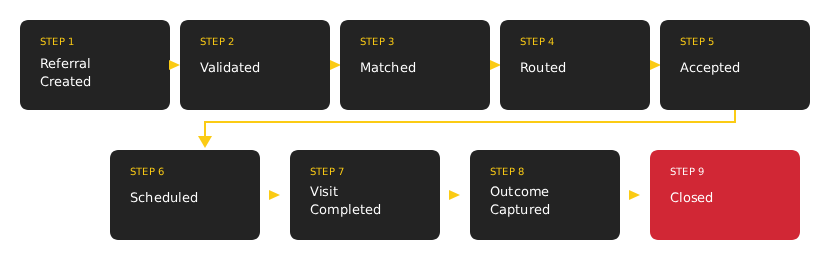
More comprehensive workflows may also include eligibility verification and EHR status or outcome write-back.
The key difference from basic referral transmission is visibility across the entire referral journey.
How Does a Healthcare Referral Platform Work?
The exact workflow varies by organization, but most platforms support five core stages.
1. Intake and Validate
The referral begins with information such as:
- Patient details
- Referring provider
- Requested specialty or service
- Clinical information
- Insurance
- Priority
- Supporting documentation
Validation helps identify missing or inconsistent information before the referral moves forward.
2. Match and Route
Provider matching may consider:
- Specialty
- Service
- Insurance and network
- Patient location
- Provider location
- Mileage
- Availability
- Capacity
Once the system identifies an appropriate destination, it can route the referral based on configured rules.
3. Accept, Schedule, and Coordinate
The receiving provider can accept or reject the referral.
If the first provider cannot serve the patient, alternative routing can help identify another appropriate option without restarting the entire process.
The workflow can then support patient outreach, appointment availability, scheduling, and status tracking.
4. Track the Visit and Outcome
A scheduled appointment does not necessarily mean care was delivered.
Referral tracking should continue through:

This allows teams to identify referrals that still require action.
5. Write Back and Close
Where integrations support it, relevant referral status and outcome information can return to the originating EHR.
The referral can then be closed once the organization's required completion conditions are met.
The result is a referral you can trace from creation to resolution.
See the Referral Workflow in Action
GridSocial connects referral intake, matching, routing, scheduling, tracking, outcomes, and closed-loop completion.
Book a GridSocial DemoWhat Problems Does a Healthcare Referral Platform Solve?
| Referral Management Problem | How a Platform Addresses It |
|---|---|
| Referrals disappear after sending | Centralized referral tracking |
| Staff manually chase providers | Status visibility and notifications |
| Referral information is incomplete | Referral validation |
| Patients are sent to the wrong provider | Provider matching |
| Providers reject referrals | Acceptance/rejection tracking |
| First-choice provider is unavailable | Alternative routing |
| Patients struggle to schedule | Appointment coordination |
| Visits cannot be confirmed | Visit tracking |
| Outcomes do not return | Outcome capture and EHR write-back |
| Referrals remain unresolved | Closed-loop completion |
The platform's value comes from connecting these activities into one referral lifecycle.
Healthcare Referral Platform vs. Manual Referral Management
| Manual Referral Process | Healthcare Referral Platform |
|---|---|
| Fax, email, or separate workflows | Connected digital workflow |
| Manual status checks | Referral-status visibility |
| Manual provider search | Structured provider matching |
| Missing information discovered later | Earlier referral validation |
| Rejected referrals require rework | Alternative routing |
| Scheduling handled separately | Connected appointment workflow |
| Staff chase appointment status | Visit tracking |
| Outcomes may never return | Outcome capture and write-back |
The goal is not simply to replace fax with software.
The goal is to create visibility and accountability across the referral process.
What Should You Look for in a Healthcare Referral Platform?
Choosing a platform should come down to one question:
Can it solve the points where your referral process currently breaks down?
Visibility Across the Referral Journey
Teams should be able to identify referrals that need attention without manual status checks.
Integration With Existing Systems
The platform should connect with the organization's EHR and existing workflows where appropriate.
Provider Selection and Alternative Routing
Provider selection should consider specialty, insurance, geography, network, availability, and other relevant criteria.
If the first provider cannot serve the patient, the workflow should support another option.
Patient Scheduling and Engagement
Look for workflows that help move the patient from referral to appointment and maintain visibility along the way.
Closed-Loop Outcomes
The platform should show whether the referral was accepted, scheduled, completed, and resolved.
Reporting, Security, and Compliance
Evaluate referral analytics, HIPAA safeguards, access controls, auditability, data handling, and integration security.
The right platform should address the gaps that cause referrals to stall, not simply add more features.
Who Uses Healthcare Referral Platforms?
Hospitals and Health Systems
Coordinate referrals across departments, facilities, specialties, and external provider networks.
FQHCs and Community Health Centers
Coordinate referrals across clinical, behavioral health, specialty, and community services.
Specialty Practices
Manage incoming referrals, scheduling, tracking, and communication with referring providers.
Care Management Organizations
Coordinate services and monitor whether patients receive recommended care.
Community-Based Organizations
Participate in referral workflows involving transportation, housing, food, and other community services.
Healthcare Referral Platforms and Closed-Loop Care
The core principle of closed-loop referral management is simple:
Referral Sent is not the same as Care Completed.
A connected process may look like:
Referral → Acceptance → Scheduling → Visit → Outcome → Closure
The referring organization can see whether the referral progressed, where it stalled, and whether the intended service was delivered.
This is particularly important when care crosses organizational boundaries.
Healthcare Referral Platforms for Clinical and Social Care
Referral management can extend beyond specialist care.
Patients may need:
- Specialty services
- Behavioral health
- Transportation
- Food assistance
- Housing support
- Utility assistance
- Other community services
Individual needs such as transportation, food insecurity, and housing instability may fall under health-related social needs (HRSN) workflows.
A platform that supports both clinical and community referrals can give care teams broader visibility across the patient's care journey.
How GridSocial Addresses Referral Management Challenges
GridSocial by SocialRoots.ai is a closed-loop referral platform designed to help organizations manage what happens after a referral is created.
Its role can be understood through four outcomes.
Find the Right Destination
GridSocial supports referral validation, eligibility workflows, provider matching, and routing.
Get the Patient Connected
Provider acceptance, patient and provider outreach, appointment availability, and scheduling help move the referral toward care.
Keep the Referral Moving
When the original destination cannot serve the patient, alternative routing can help identify another appropriate provider.
Confirm the Outcome
Visit tracking, outcome capture, EHR write-back, notifications, and closed-loop completion help referring teams understand what happened.
The workflow can be summarized as:
Find → Connect → Continue → Confirm
The goal is simple:
Give care teams visibility into every referral and help keep patients moving toward the intended service.
How to Measure Healthcare Referral Management Performance
Once organizations track referrals digitally, they can identify where the process is working and where patients get stuck.
Important measures may include:
- Referral completion rate: How many referrals result in the intended service?
- Referral leakage: How many fail to reach completion?
- Time to appointment: How long does scheduling take?
- Time to completion: How long does the full referral journey take?
- Acceptance and rejection rates: How often are referrals accepted or rejected, and why?
- Appointment completion: How many scheduled patients receive care?
- Referral aging: Which referrals remain unresolved?
- Provider performance: Which providers consistently accept and complete referrals?
These measures can help organizations identify delays, leakage, and care-coordination gaps.
Frequently Asked Questions
A healthcare referral platform is a digital system that helps organizations create, route, track, coordinate, and complete patient referrals.
It keeps referrals visible after they are sent and helps teams identify stalled referrals before they remain unresolved.
Referral tracking primarily shows referral status. A broader referral platform can also manage validation, matching, routing, scheduling, outreach, outcomes, and closure.
Yes. Depending on the platform and implementation, integration can support referral creation, information exchange, status updates, and outcome write-back.
Some platforms support referrals to community-based organizations and social services in addition to clinical referrals.
They can reduce manual status checks, identify incomplete referrals, support routing and scheduling, and show which referrals require action.
Conclusion: What Makes a Healthcare Referral Platform Effective?
An effective healthcare referral platform does more than send referrals electronically.
It gives teams visibility into whether a referral was:
Received → Accepted → Scheduled → Completed → Resolved
The goal is to reduce delays, minimize manual follow-up, and help patients reach the intended care or service.
GridSocial by SocialRoots.ai connects provider matching, referral routing, scheduling, tracking, outcomes, and EHR updates within a closed-loop workflow.
The goal is not just to send the referral. It is to know what happened next.
Related Resources